Investment PhilosophyWe fish where the fish are.
We do not operate within the well-known equity indices with our investment strategy, but rather in areas outside the mainstream.
Spin-offs
Spin-offs involve the separation of one or more business units, which are typically distributed to the parent company’s shareholders free of charge. Such separations can occur for various reasons.
In most cases, a sharper focus on core operations is a key driver: the parent company believes it can concentrate more effectively on its core competencies rather than being spread across two or more distinct areas. Alternatively, management may conclude that certain business segments lack strategic fit, and that the value of the individual parts would be better reflected in the public markets if operated independently.
Spin-offs typically receive limited attention from the market and are often poorly understood by investors. This is unjustified, as historical evidence shows that both the parent company—and in particular the spin-offs—tend to outperform following the separation. Unlike an IPO, shares in a traditional spin-off are not sold but distributed directly to the parent company’s shareholders.
Many shareholders have little interest in the spin-off, having originally invested for exposure to the parent company. As a result, they often dispose of the spin-off shares within the first few months. In addition, spin-offs are frequently excluded from indices due to their smaller market capitalisation or differing sector classification. Consequently, index funds and ETFs are forced sellers of these securities.
Furthermore, initial analyst coverage is typically limited, as investment banks generate little revenue from spin-offs and therefore often do not provide research. Financial databases also tend to contain only a limited operating history in the early months, making quantitative screening difficult.
At the same time, a clearer strategic focus on core operations generally leads to operational improvements and a re-rating, as the market can more easily assess the underlying value of both the parent company and the spin-off. The initial selling pressure therefore often proves to be an attractive entry point.
Ferrari is the globally renowned manufacturer of luxury sports cars and Formula One racing vehicles, which was spun off from the automotive conglomerate Fiat Chrysler in 2016.
Ferrari is not merely a car manufacturer, but a luxury goods company—effectively an exclusive club with a loyal customer base, with around two-thirds of customers being repeat buyers. Supported by constrained supply relative to demand, limited special editions and new hybrid models, margins and returns on capital are expected to increase further, potentially reaching levels comparable to those of Hermès in the coming years.
Investment processInvestigative research is the key driver of our investment process
Investments in hard-to-access areas outside the mainstream create barriers that keep most investors away. As a result, valuations remain low and return potential high. Assessing spin-offs, related variants (split-offs, equity carve-outs, Reverse Morris Trusts) and the parent companies requires rigorous analysis and a deep understanding of the underlying businesses.
Quality over quantity.
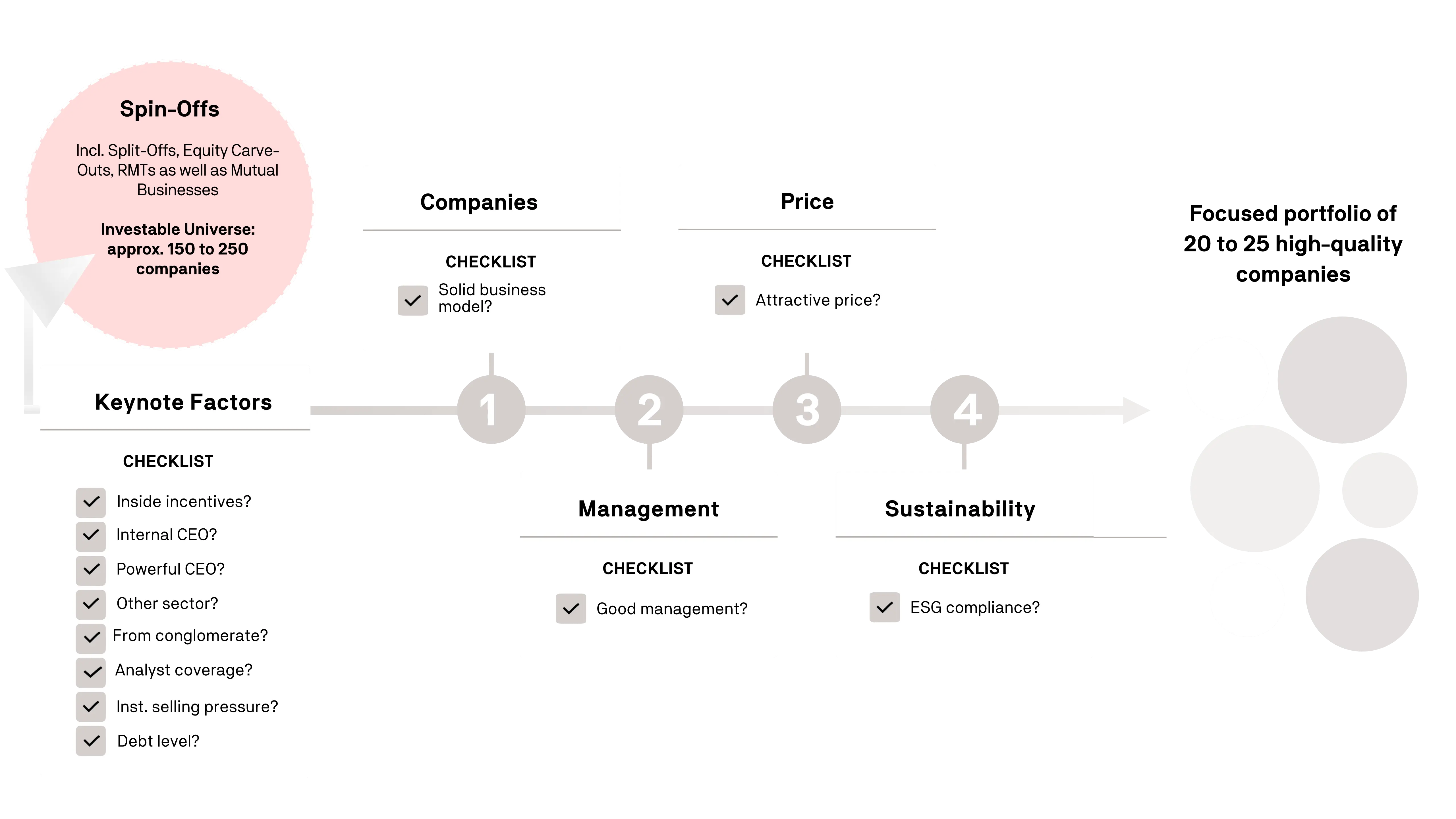
Our investment universe consists of a dynamic, global list of approximately 150 to 250 divestments (spin-offs, split-offs, carve-outs, Reverse Morris Trusts and parent companies). The focus is on companies in the pre-spin phase, with a lead time of up to 12 months, through to post-spin situations up to five years after the divestment.
Announced divestments, the parent companies’ strategic rationale for the separation, the financial terms of the transactions, and the resulting risks and opportunities are analysed on an ongoing basis. The “Keynote success factors” are incorporated through a structured checklist.
Structure of the spin-off
- Where is value created — the parent or the spin-off?
- Spin-off relatively small compared to the parent company
- Spin-off operating in a different sector
- Spin-off originating from a conglomerate
Market neglect
- Institutional investors do not want the spin-off (selling pressure)
- Limited analyst coverage
- Limited financial history (cumbersome information gathering, no quantitative screening)
Incentives
- Insiders favour the spin-off (insider buying)
- Incentive structure / direct alignment of management incentives
- “Inside CEO”?
Capital structure
- Leverage: tendency towards over-indebtedness in some spin-offs
- Strong free cash flow generation to reduce debt, or low leverage?
Quality
- Tendency for improvements in growth, margins and returns on capital following a spin-off
Valuation
- Low valuation relative to the peer group / broader market?
- Unique business models / lack of a comparable peer group
Keynote four-filter approachOnly high-quality companies make it into our portfolio
Before inclusion in the fund portfolio, each company is thoroughly assessed using our objective Keynote checklist, comprising around 50 investigative criteria
High-quality company
Strong companies are characterised by:
- Non-replicable assets (brands, network effects, patents, cost leadership)
- Sustainably high returns on capital
- Reinvestment opportunities
Excellent management
We favour management teams that:
- Have “skin in the game”, i.e. hold equity in the company
- Deliver on their commitments
- Have a proven track record
Attractive price
To identify the optimal combination of current valuation and future growth opportunities:
- We focus on the free cash flow yield relative to the potential over the next three to five years
- Our primary emphasis is on the quality of the business model (high returns on capital and attractive reinvestment opportunities), and thus on the intrinsic value of a share
- We remain disciplined to avoid overestimating a company’s potential
Low ESG reputational risks
As sustainability criteria represent an important success factor:
- We incorporate sustainability considerations when assessing the business model (at the level of products and services)
- We apply active and rigorous monitoring of ESG-related reputational risks
- We continuously analyse and monitor portfolio companies
Keynote checklistEvery company is examined in depth
Before inclusion in our fund portfolio, each company is thoroughly assessed using our objective Keynote checklist, comprising around 50 investigative criteria
Items on our checklist include, among others:
- A high return on capital employed (ROCE)
- Above-average reinvestment opportunities and growth prospects
- A strong market position
- A low level of leverage
- The generation of strong free cash flow (FCF)
- A capable management team with a proven track record