All Publications
Monatsbericht

Assessment of the current situation on the equity markets – September 2022

Published onReading time 6 minutes
Rising inflation and climbing interest rates, an energy crisis and a global recession – the investor consensus appears clear. Investors do know what has happened this year. It is unclear, however, how much of the macroeconomic environment (or of what the investor consensus takes the macroeconomic environment to be) is reflected in today's asset prices. A negative macro outlook is not to be equated with falling prices, just as a positive macro outlook does not necessarily mean rising prices. Markets are as a rule most inefficient when a macro narrative predominates, when market participants narrow their time horizon and lose focus on the fundamentals of companies.

It thus appears that only macroeconomics still counts on the financial markets and that investors hang on every word of the US Federal Reserve. Inflation is currently clearly the most important factor influencing daily market movements, as the markets fear aggressive interest rate steps by the central banks. For in combination with the high energy costs, a recession and further falling asset prices would then be a foregone conclusion.

An alternative perspective: «peak inflation»

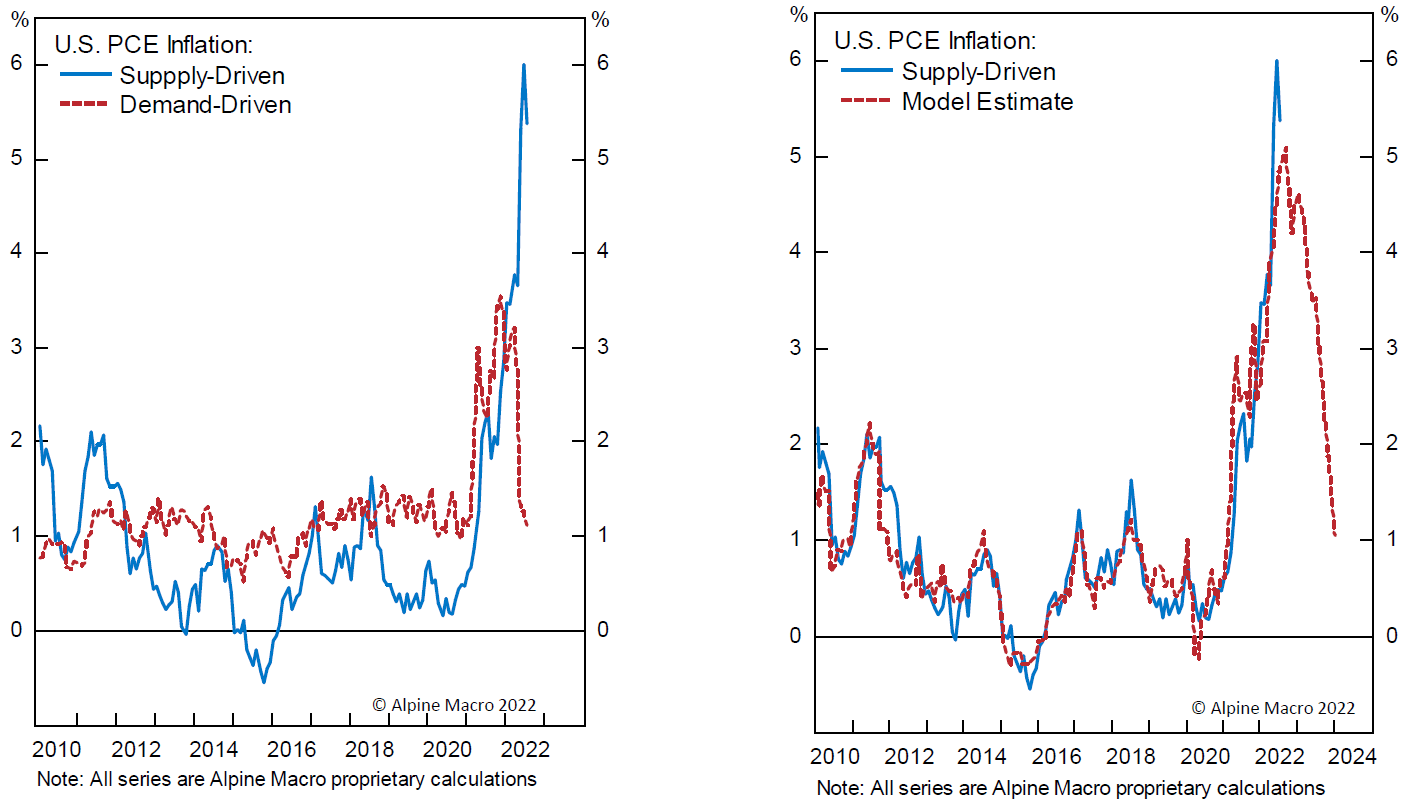
The macroeconomic forecasters appear relatively «self-assured» with regard to the scenario described above. But what if inflation were to decline faster than the markets expect? The research house Alpine Macro has divided the PCE (Personal Consumption Expenditures) inflation tracked by the US Federal Reserve into two categories: supply-driven inflation (rising price, falling volume) and demand-driven inflation (rising price and rising volume). Demand-driven inflation has been declining sharply since mid-year and has already fallen to 1% (see the red chart in the graphic bottom left), while supply-side inflation (blue chart) is still high but likewise trending downwards. «Micro indicators» from companies across various industry groups, such as order backlogs, delivery times, transport and raw-material costs, confirm the picture that supply-driven inflation is already receding.

Angebotsbedingte (blauer Chart, Grafik links) und nachfragebedingte Inflation (roter Chart, Grafik links) I Angebotsbedinge Inflation (blauer Chart, Grafik rechts) und Modellschätzungen für Entwicklung der PCE-Inflation (roter Chart, Grafik rechts) bis Ende 2023

Source: Alpine Macro

The model calculations of Alpine Macro, which historically have moved very closely in step with supply-driven inflation, even indicate that PCE inflation in the USA will fall to 1% by the end of 2023 (graphic top right, red chart). Monetary policy thus appears to be working, and the front-loaded character of the tightening cycle is likely to take effect through weaker growth and declining price pressure in the fourth quarter of 2022 and in 2023. The question, however, is whether the process is also proceeding quickly enough for the Fed.

High pessimism and volatility offer opportunities

With price declines of -25% in nominal terms and -30% in real terms so far this year, the leading US exchange is already pricing in a mild recession. Indicators that measure investor sentiment are signalling high pessimism.

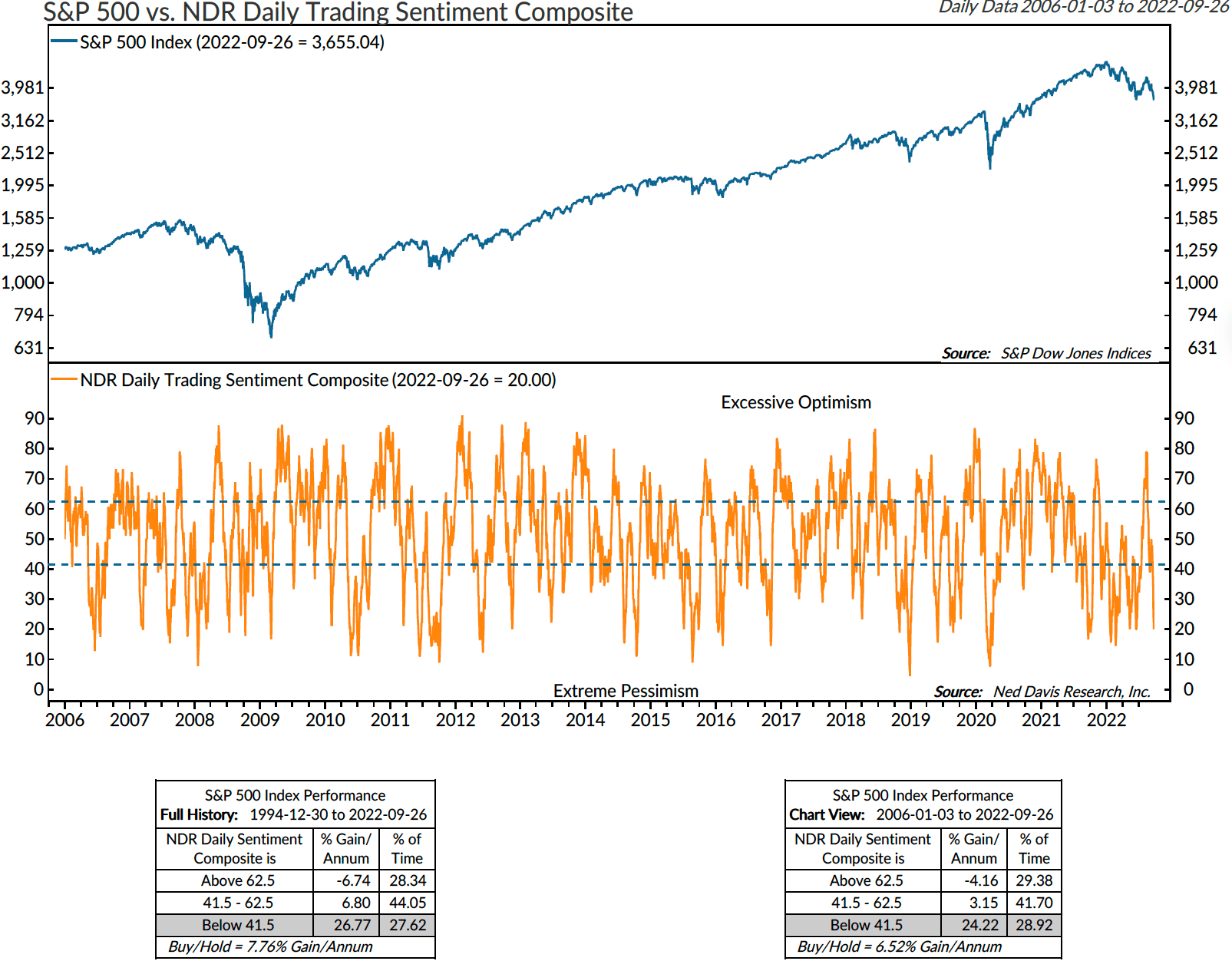
The Bull-Bear Spread of the American Association of Individual Investors (AAII) has reached a bearish extreme that is higher than during the financial crisis of 2008. According to the latest fund manager survey by the Bank of America, the proportion of portfolio managers underweighting equities exceeds the level of 2008/09. Net short positioning in the S&P 500 is high, and the NDR Daily Trading Sentiment Composite compiled by Ned Davis Research (orange chart below) has fallen below 20%, thereby likewise signalling very negative sentiment, which from a contrarian perspective is positive: since 1995, the S&P 500 Index has risen by 27% p.a. whenever the NDR Trading Index stood below 41.5% (see the table bottom left). When fear is great, it is more likely that prices already incorporate a worst-case scenario – in reality it then rarely turns out to be as bad as feared.

S&P 500 Index (blau) vs. NDR Daily Trading Sentiment Composite (orange)

Source: Ned Davis Research

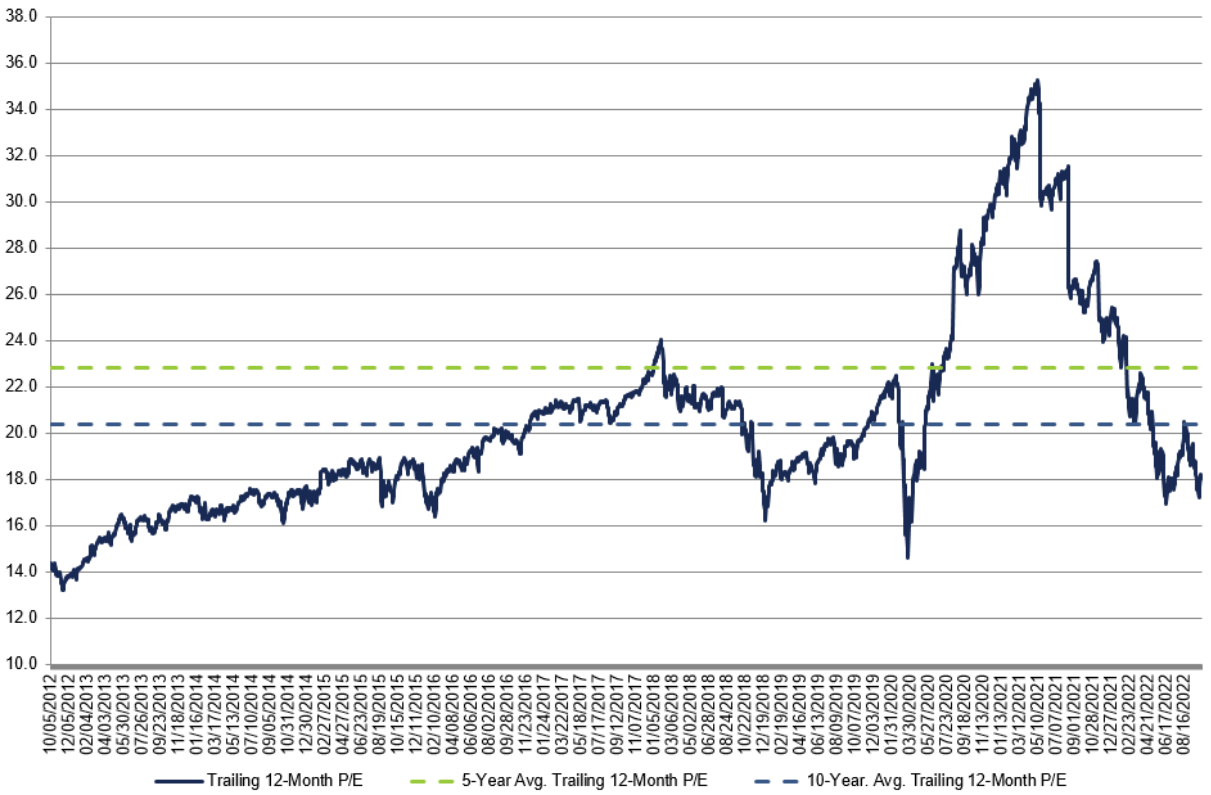
It is not difficult today to sell a pessimistic story. Yet the financial markets are already aware of the negative factors. No one knows, not even the bears, how the future will unfold. However, buying equities amid high volatility and declining markets has, as a rule, proven a successful strategy in the past. The price/earnings ratio (P/E) of the S&P 500 Index has already fallen to a level comparable with earlier recessions. According to Factset, the 12-month P/E for the S&P 500 Index stands at 18 and is thus below both the 5-year average (22.8) and the 10-year average (20.4), see the chart below.

12-Monats-KGV des S&P 500 Index vs. 5-Jahres Durchschnitt (grüne gestrichelte Linie) und 10-Jahres-Durchschnitt (blau gestrichelte Linie) von 2012 bis 2022

Source: FactSet

In the event of a recession, earnings in the USA are likely to fall by 10% over the coming 12 months. Yet even in such an environment the P/E ratio could rise if bond yields fall to 2.5% or lower. For it is not consistent to forecast a recession and a decline in earnings while at the same time expecting bond yields to remain at 4%.

Selective buying opportunities for long-term investors

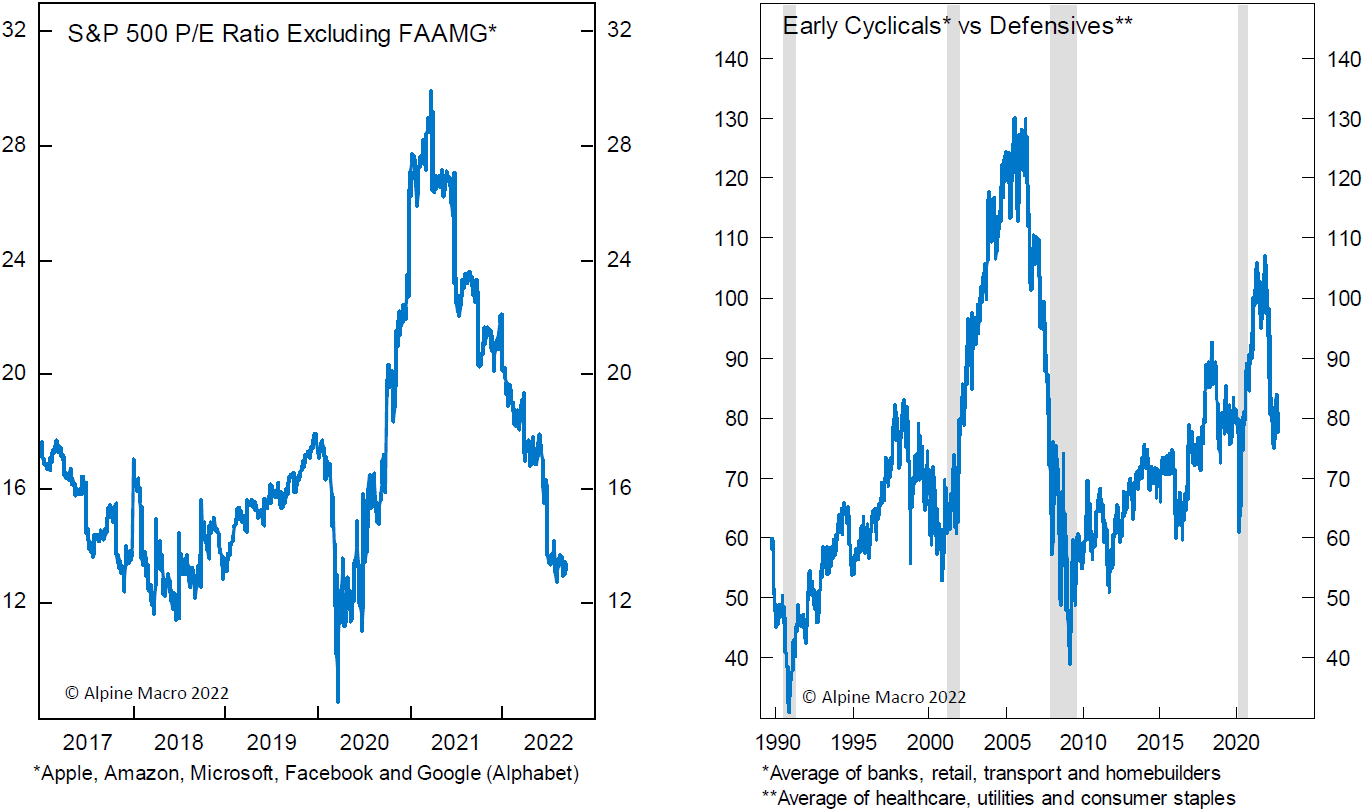
Even should a mild recession occur, a large part of it is by now priced into cyclical equities, for example in the technology and industrial sectors, in which many stocks have already fallen by 30 to 50%. As can be seen from the graphic bottom left, cyclical equities have performed markedly worse than defensive equities since the middle of last year. The relative performance thus resembles the price development of past downturns and recessions respectively (shaded grey).

As the graphic shows, cyclical equities have in the past anticipated recessions and marked their low points in the midst of the recession. Market dislocations such as the current one have therefore in the past been outstanding opportunities to invest in attractively valued, more cyclical companies, which as a rule outperformed in a subsequent upturn.

Zyklischen vs. zyklische Aktien (links) I S&P 500 P/E Ration ex FAAMG-Aktien (rechts)

Source: Alpine Macro

The graphic top right shows that the leading index S&P 500, excluding the heavily weighted FAAMG index constituents (Apple, Amazon, Microsoft, Facebook and Google), is valued at a P/E of 12 and is anything but expensive. This time, too, the market has thrown out the baby with the bathwater – a look beneath the mega-cap stocks should therefore be worthwhile.

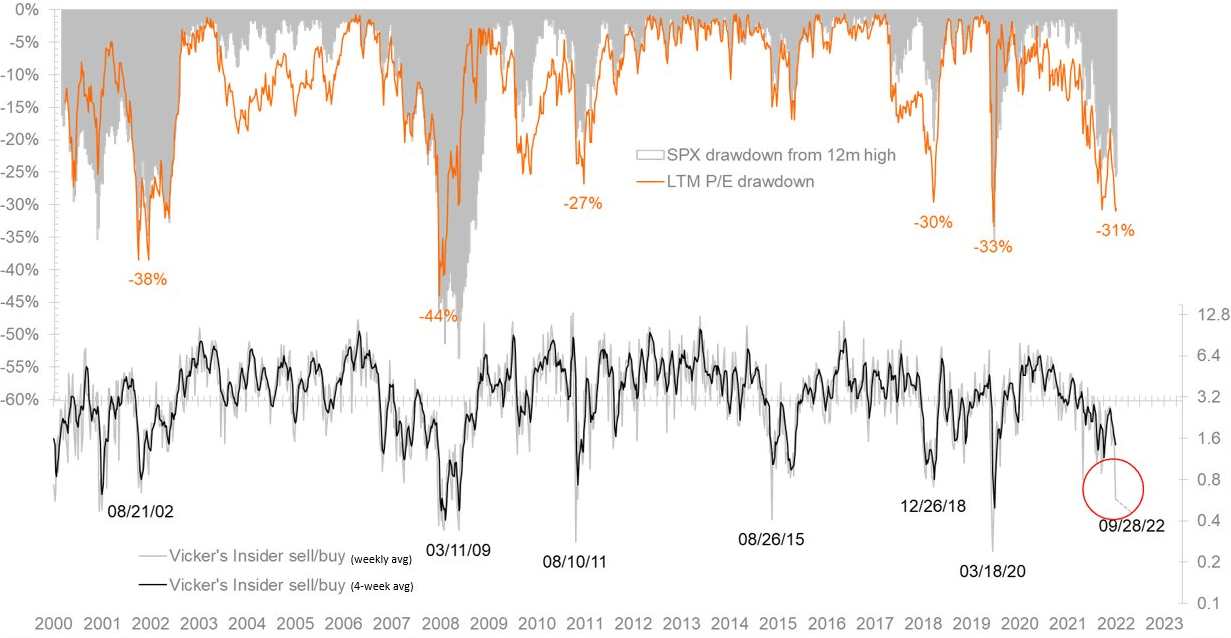
In the short term, equities are traded on the basis of noise and valuations are largely irrelevant. As a consequence of short-term concerns about supply chains, recession or high short-term comparison hurdles, many high-quality companies in the S&P 500 are trading at attractive valuations. Company leaders evidently see it this way too. Following the recent sell-offs, corporate insiders have once again bought shares in their own companies on a large scale (see the illustration below, second section). Insiders sell shares for all manner of reasons, but they buy for only one reason: because they believe that prices will rise. In view of the historical accuracy at low points (March 2020, December 2018, August 2015, August 2011, March 2009, August 2002), the glass is likely to be not half empty but rather half full.

Korrekturen im S&P 500 (grau) und KGV-Kontraktionen (orange) vs. Insider Verkäufe/Käufe (Abschnitt unten: grau = wöchentlicher Durchschnitt; schwarz = 4-Wochen-Durchschnitt)

Source: Fidelity, FMRCo, Haver Analytics, FactSet
Markets are as a rule most inefficient when a macro narrative predominates, when market participants narrow their time horizon and lose focus on the fundamentals of companies. When investors, in search of short-term gains, lose sight of the fundamentals of companies, this opens up opportunities for long-term investors. Rather than macroeconomic forecasts, it is precisely then worthwhile to look at what is essential, namely the «micro environment»: the attractiveness of sectors, industries and individual companies.

Should you wish for further information, please do not hesitate to contact us.

Welcome to Keynote Funds

In order to display tailored information, please provide the following:

Important legal information (Disclaimer)

The following section of the KEYNOTE FUNDS AG website contains information and opinions on investment instruments, products and services (hereinafter collectively referred to as “financial products”). You may only access the section on financial products if you have carefully read and subsequently accepted the following important legal notices for financial products. If you have not understood or do not accept one or more provisions, we ask you to leave the KEYNOTE FUNDS AG website.

By giving your consent and accessing the following section of the website containing information and opinions on financial products, you declare that you have understood the legal notices and expressly agree to them.

Local legal restrictions

The products described on this website may not be offered for sale in all countries and are in any case reserved for the group of investors entitled to purchase the products. The information and content of the KEYNOTE FUNDS AG websites is therefore not directed at natural or legal persons whose place of residence or business is subject to a legal jurisdiction that restricts the distribution of such information. Natural or legal persons whose place of residence or business is subject to a foreign legal jurisdiction should inform themselves about the said restrictions and observe them accordingly.

In particular, the information contained on the KEYNOTE FUNDS AG website is not intended for the USA. US citizens as defined in Regulation S of the US Securities Act of 1933 and legal entities resident in the USA are prohibited from accessing the KEYNOTE FUNDS AG website. Furthermore, information provided on this website may not be distributed or passed on in the USA. The products may not be sold or offered to US citizens or legal entities resident in the USA.

No recommendation or offer

The information and opinions published on the websites of KEYNOTE FUNDS AG are not intended as investment advice and in no way constitute advice on legal, tax, economic or other matters. They are for informational purposes only. Subscriptions should in any case only be made on the basis of the current sales prospectus, the key investor information document (KIID) and the most recent annual and semi-annual reports. All relevant fund documents are available free of charge from the responsible custodian/depositary bank or from the management company Universal-Investment at www.universal-investment.com. We also recommend that you contact your customer advisor or other specialists before each investment.

Information on the service providers

  • Investment company:Keynote (SICAV)
  • Investment Manager:Keynote Funds AG, Zurich
  • Management company:Universal-Investment-Luxembourg S.A.
  • Custodian:UBS Europe SE, Luxembourg Branch
  • Auditor:KPMG Luxembourg
  • Distribution companies:Greiff capital management AG

No liability

Although KEYNOTE FUNDS AG believes that the information contained herein is based on reliable sources, no warranty can be given for the quality, accuracy, timeliness or completeness of the information contained in this document.

KEYNOTE FUNDS AG expressly reserves the right to change, supplement or delete parts of the website or the entire website without prior notice. All published information, in particular price and calculation data or forecasts, is based on the state of knowledge and/or market assessment at the time stated in the respective information.

Any liability of KEYNOTE FUNDS AG for damages of any kind (including consequential damages) arising directly or indirectly from access to the KEYNOTE FUNDS AG websites is excluded, with the exception of intentional or grossly negligent conduct.

KEYNOTE FUNDS AG also assumes no responsibility and gives no warranty that the functions of the website with content on the financial products will not be interrupted or are error-free, that errors will be corrected or that the website or the respective server is free of viruses or other harmful components and programs.

Risk warning

Historical performance is not an indicator of current or future performance. The performance data does not take into account the commissions and costs charged on the issue and redemption of units, nor any potentially value-reducing custody account fees or withholding taxes.

As a general rule: the higher the risk (price fluctuations), the longer the investment period should be, and the higher the potential returns. The value of the invested capital as well as the income derived from it (e.g. distributions in connection with investment funds) are subject to fluctuations or may be entirely lost.

Investments in foreign currencies are additionally subject directly and indirectly to exchange rate fluctuations. Distributions in connection with funds and other investment instruments may also vary. There is therefore a risk that you will only receive back a portion of the originally invested amount. A total loss cannot be ruled out either. We ask you to study in detail the risks associated with an investment instrument, in particular the risk notices in the current sales prospectus of the respective fund, and the brochure “Risks Involved in Trading Financial Instruments” (https://www.swissbanking.org/de/services/insight/insight-4.19/neue-broschuere-zu-risiken-im-handel-mit-finanzinstrumenten by SwissBanking. We would also like to point out that the liquidity of fund units and other investment instruments may be limited.

Performance

Positive past performance is not a guarantee of positive future performance. KEYNOTE FUNDS AG and its contractual partners can therefore give no guarantee for the preservation (or increase) of the value of the invested capital, and investors must be willing and able to bear any substantial losses or even total losses.

In calculating performance, any fees and costs incurred on the purchase, holding or sale of the financial product (e.g. commissions and costs charged on subscription and redemption of fund units) are not taken into account.

Intellectual property

All content on this website is protected by copyright and is the property of KEYNOTE FUNDS AG, unless expressly stated otherwise. No part of this website grants any license or rights of use to images, texts, trademarks or logos. Downloading or copying the website does not transfer any legal rights to software or material contained on it.

Any reproduction or republication of the contents of this website requires the written consent of KEYNOTE FUNDS AG and an explicit citation of the source.

Changes to the terms of use

KEYNOTE FUNDS AG reserves the right to change these terms of use from time to time. We therefore ask you to read these terms of use each time you access the KEYNOTE FUNDS AG websites and to check whether you also agree with the new version. If you have not understood or do not accept one or more of the provisions of the current terms of use, we ask you to leave the KEYNOTE FUNDS AG websites.

Links to other websites

The KEYNOTE FUNDS AG websites may contain links to websites which are not controlled and offered by KEYNOTE FUNDS AG. These links are entirely outside the control of KEYNOTE FUNDS AG. Activating a link is at your own risk. No warranty or liability, express or implied, is assumed for the content of such websites, including their accuracy, completeness, reliability and suitability for particular purposes. KEYNOTE FUNDS AG does not guarantee that such websites or their content do not give rise to any copyright or trademark claims or other infringements of the rights of third parties, nor that such websites or their content are free from viruses or other harmful components.

Applicable law / place of jurisdiction

Access to and use of the KEYNOTE FUNDS AG website as well as the present important legal notices for financial products are subject to Swiss law. The exclusive place of jurisdiction is Zurich, Switzerland: Ombudsman: Verein Ombudsstelle Finanzdienstleister (OFD), Bleicherweg 10, 8002 Zurich.

There were errors in your input

We are sorry

In Switzerland, only professional investors may access the website.