Deep Dive: Sandoz
Why the Novartis spin-off offers an attractive investment opportunity
Published onReading time 20 minutes
The large pharmaceutical manufacturers are confronted with growing competition, price pressure and a lack of growth. To address these challenges, Big Pharma is increasingly focusing on innovative drugs and parting with areas that do not belong to the core business. On 4 October, Novartis will spin off its generics and biosimilars division as Sandoz. The spin-off is met with much scepticism, since Sandoz was regarded as the problem child within Novartis on account of a declining business and low margins. Yet the prospects of a Sandoz released into freedom are better than the market currently assumes.
Big Pharma – and increasingly the leading biotech companies too – face growing problems on account of their sheer size, with revenues of more than 10 billion US dollars each: less pricing power than in the past, growing competition for biotech drugs, and limited scope to generate large revenues once again in key therapeutic areas.
Large pharmaceutical companies such as Astra-Zeneca, Bristol-Myers, GlaxoSmithKline or Pfizer are today the result of large mergers, generally driven by cost savings, or the outcome of several larger acquisitions. Many of them have become victims of their own success: they launched successful blockbuster drugs, but struggle to develop a new drug that is significantly better once their original drug goes generic and the price falls dramatically. As a consequence of the mergers and acquisitions, many of the large pharmaceutical companies have failed to underpin their high revenue base with organic product innovation driven by internal research and development.
Structural challenges for Big Pharma and Big Biotech
In addition to the points mentioned at the outset, Big Pharma and Big Biotech groups were and still are confronted with three structural challenges:
- Generics
- Pharmacy Benefit Managers
- Biosimilars
Generics
Generics are therapeutically equivalent versions of branded prescription medicines in terms of quality, safety, dosage form, strength, route of administration and intended use. Generics generally become available once the patents and other exclusivity rights for the original preparations of the branded manufacturers expire. Generics are usually offered at considerably lower prices (in many cases at a discount of 80 to 85%) than the original preparations, since generics manufacturers do not have to repeat the animal trials and clinical studies (in humans) that would have been required for a new therapeutic drug. However, all generics must demonstrate bioequivalence, i.e. they must exhibit the same quality, safety and efficacy as their reference medicines and are considered fully substitutable.
In contrast to other industries, pharmaceutical companies operate on a treadmill: if they fail to introduce new, innovative drugs that are safe and much better than their low-cost generic alternatives, they face the risk of their business disappearing in a little more than a decade. In 2005, 60% of all drugs prescribed in the US were generics. By 2021 the figure was already 92% (see chart below). Viewed purely from a prescription perspective, branded medicines have lost 80% of their market share to generics over the past 16 years. Globally, the market for generics was estimated at a volume of 185 billion USD at the end of 2022. The generics market is expected to grow by 5% p.a. over the course of the coming decade.
Source: IVQIA, Statista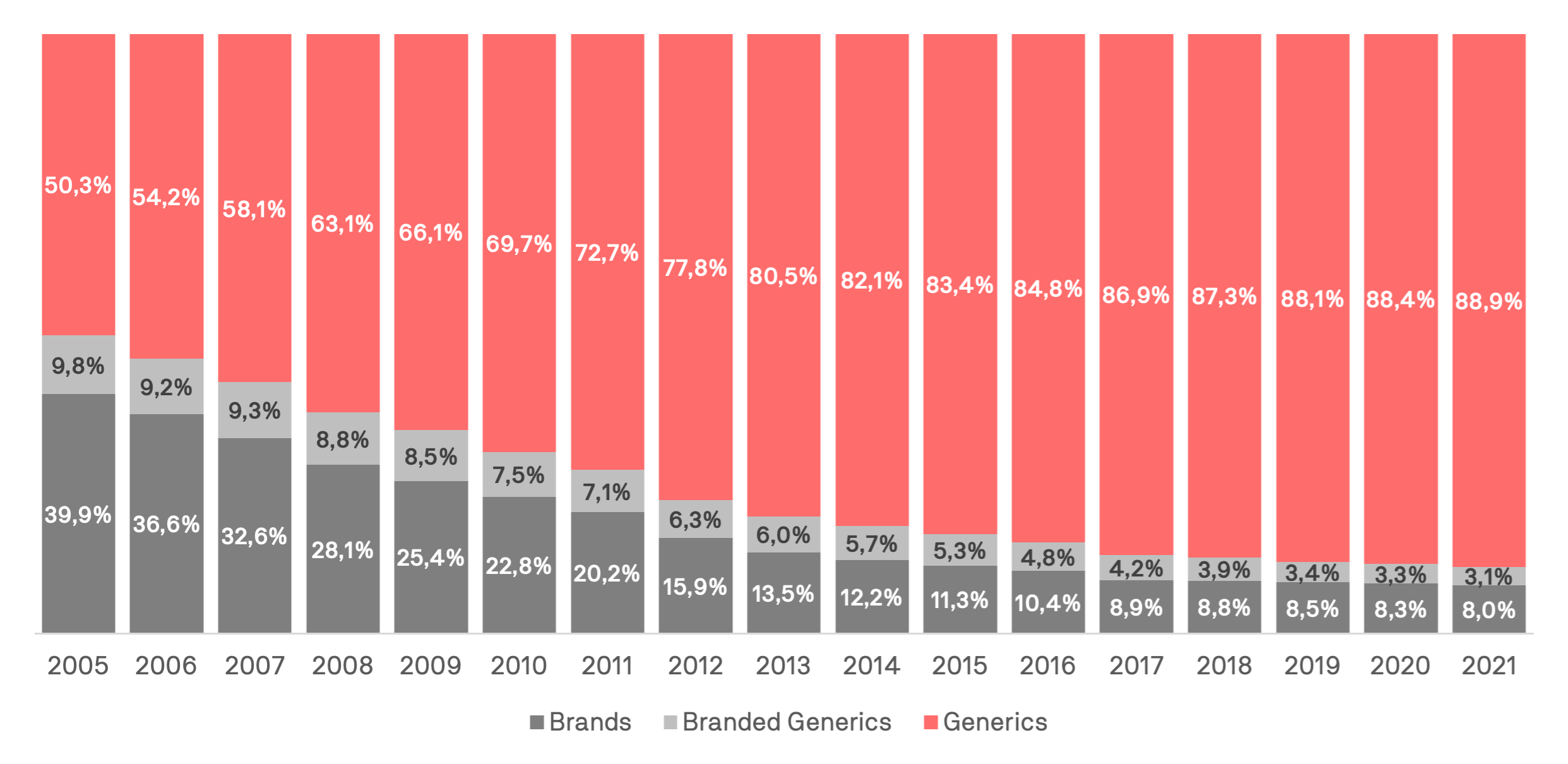
Pharmacy Benefit Managers
In the US, huge purchasing organisations known as Pharmacy Benefit Managers (PBM) negotiate drug prices between pharmacies, health insurers and employers. The PBM industry has consolidated strongly in recent years, thereby gaining market power and negatively affecting the revenues of the pharmaceutical industry. The consequence: for drugs that are not highly differentiated, a PBM grants a pharmaceutical company a higher market share if, in return, that company offers a large volume discount.
The PBM's customers can still access medicines that are not on the drug list, but the consumer may under certain circumstances have to make higher co-payments and/or the prescribing physician must overcome several hurdles. Moreover, new drugs that are only marginally better than the generic alternative have difficulty gaining acceptance, because the cost-benefit analysis does not justify their use. This affects, for example, drugs for cholesterol or respiratory diseases that used to generate several billion dollars in revenue, but for which very effective generic alternatives now exist.
Biosimilars
Biosimilars are lower-cost alternatives to existing biotechnological medicines that are no longer under patent protection. They are synthesised from living organisms, tissues or cells. As with generics, biosimilars may not exhibit any significant clinical differences in the safety and efficacy profile compared with their reference medicines in order to be considered interchangeable.
Biosimilars have a larger molecular size and a more complex structure compared with low-molecular-weight generics that are relatively simple to manufacture, which increases the cost and complexity of their development and production. The result is that many biotech drugs can still generate relatively high revenues even after the patent on their original chemical composition has expired.
The development of biosimilars can take six to nine years and cost 100 to 300 million USD per drug, whereas a simple, low-molecular-weight generic requires only 1–2 million USD in costs and a development time of about two years. The higher development costs and the greater technological and regulatory hurdles result in less competition – even when a biosimilar is on the market, the price of the original preparation falls considerably less.
Yet biosimilars are rapidly gaining market share in Europe – and, with a time lag, in the US and worldwide – across various product categories, so that the pressure on Big Pharma will increase here as well. At the end of 2022, the market for biosimilars amounted to about 23 billion USD. The market is expected to grow by 20% p.a. over the course of the coming decade.
The response of Big Pharma and Novartis
Faced with these challenges, many pharmaceutical companies have begun to offer their innovative, new drugs at considerably higher prices in order to support their revenues. In the long term, they run the risk that this strategy provokes a backlash from politicians and consumers, thereby eroding their pricing power. At the same time, many pharmaceutical firms have invested aggressively in research and development in therapeutic areas that promise high growth, and have also increased their inorganic investments in these areas through acquisitions. The oncology (cancer) field in particular is today the focus of many pharmaceutical companies. To shoulder the high investments, non-core areas were divested, or drugs and pipeline assets in which a company is not a leader were exchanged with other pharmaceutical companies by means of asset swaps, or spun off.
Over the past decade, the Swiss pharmaceutical giant Novartis has made use of several such transactions in order to part with non-core areas:
- Asset swap with GlaxoSmithKline (April 2014): sale of the vaccines business (900 million USD in revenue) for 5.25 billion USD to GSK, with the potential to increase the sale price to 7.05 billion USD if various milestones are reached. In return, GSK sold its oncology business (1.6 billion USD in revenue) for 14.5 billion USD to Novartis, with the potential for a sale price of 16 billion USD (depending on the outcome of a specific ongoing study).
- Joint venture with GlaxoSmithKline (April 2014): Novartis and GSK agree to contribute their over-the-counter pharmaceutical business to a JV, in which Novartis holds 36.5% and GSK holds 63.5%.
- Sale to Eli Lilly (April 2014): in a separate transaction, the sale of the animal health business to Eli Lilly for 5.4 billion USD was announced.
- Spin-off of Alcon (April 2019): the spin-off of Novartis's eye care division by means of a dividend in kind to its own shareholders.
- Sale of the Roche shares (November 2021): Novartis and Roche agree a bilateral transaction for the sale of Roche bearer shares (about 33%) held by Novartis at a total price of 20.7 billion USD.
As the final step in these portfolio adjustments, Novartis is set to carry out, on 4 October 2023, the spin-off of Sandoz (generics and biosimilars) to Novartis shareholders by means of a dividend in kind. Novartis's focus on five core therapeutic areas (cardiovascular, immunology, neuroscience, solid tumours and haematology) and the creation of a concentrated, innovative medicines company thus take further shape.
The Sandoz spin-off
The spin-off of Sandoz from Novartis is carried out through the distribution of a dividend in kind by Novartis, which is tax-free. For every five Novartis shares, shareholders receive one Sandoz share. Any fractions will be settled not in shares but in cash. In total, 431 million Sandoz shares will be issued. Following the spin-off from Novartis, the Sandoz shares will not belong to the leading Swiss equity index, the Swiss Market Index (SMI), but will be part of the Swiss Leader Index (SLI), which comprises the 30 largest and most liquid stocks.
Business model overview
Sandoz operates in two market segments: generics and biosimilars, which together form the market for off-patent medicines. While many drug manufacturers concentrate on one of the two markets for off-patent drugs, Sandoz is well positioned with a strong presence in both markets.
Source: Unternehmensdaten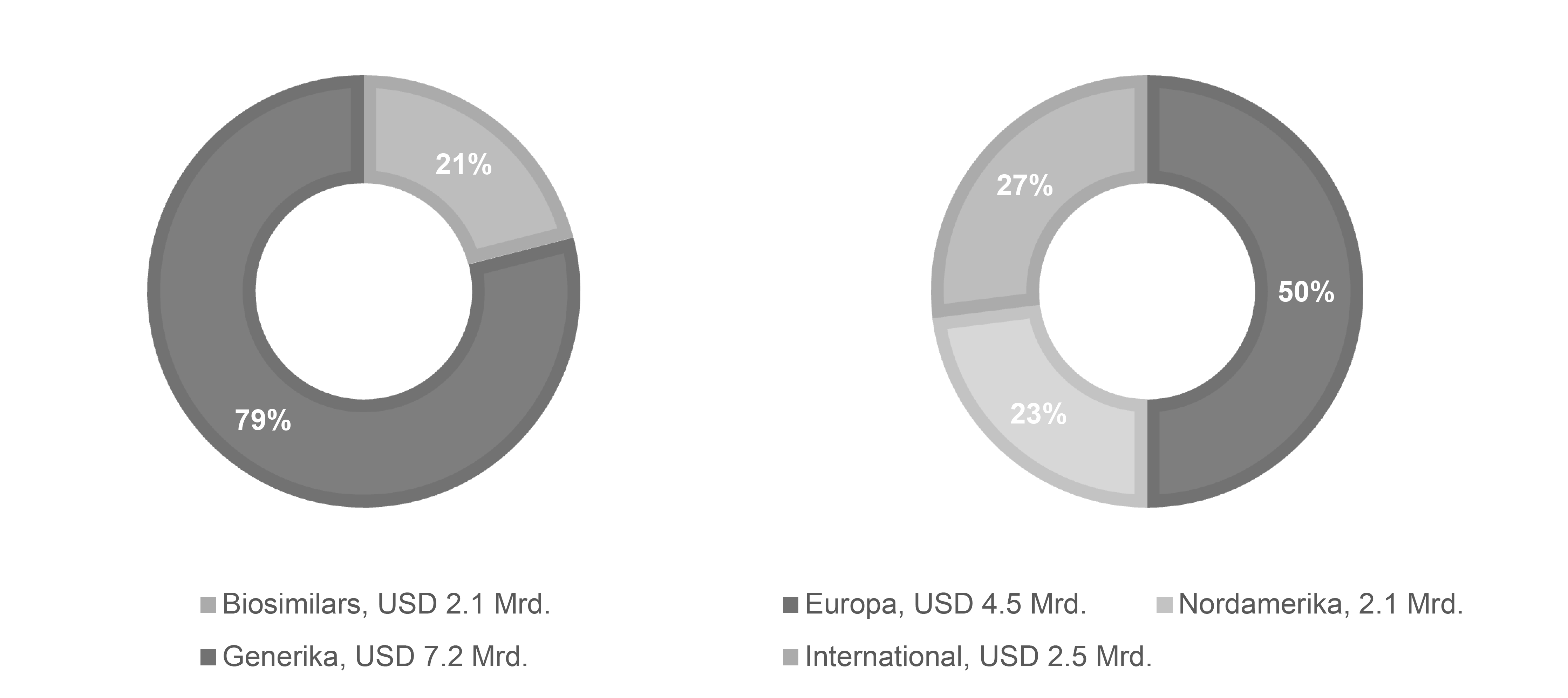
Generics division
Sandoz's global portfolio comprises about 1,500 products, ranging from standard oral preparations to complex generics such as injectables and respiratory inhalers. These products cover the most important therapeutic areas, including cardiovascular, central nervous system, oncology, anti-infectives, as well as pain and respiratory diseases. The company has one of the broadest portfolios in the industry. The pipeline comprises around 400 preparations, which will be brought to market over the next few years.
Wichtigste Biosimilars-Lancierungen
Originalpräparat | Therapeutische Bereiche | Umsatz des Originalpräparate | Aktueller Status |
|---|---|---|---|
Humira© (adalimumab) | Immunologie (rheumatoide Arthritis) | ca. 21 Mrd. USD p.a. | In Europa und den USA zugelassen, in den USA im Juli 2023 lanciert |
Tysabri© (natalizumab) | Neurologie/Immunologie (Multiple Sklerose, Morbus Crohn) | ca. 2 Mrd. USD p.a. | Zulassung in Europa und den USA beantragt |
Prolia©/Xgeva© (denosumab) | Knochenkrankheiten/Onkologie (Osteoporose, Knochenkrebs) | ca. 7 Mrd. USD p.a. | Zulassung in Europa, den USA und Kanada beantragt |
Eylea© (aflibercept) | Ophthalmologie (feuchte Makuladegenration) | ca. 11 Mrd. USD p.a. | Positive Phase III-Ergebnisse präsentiert |
Quelle: Unternehmensdaten, Keynote
Biosimilars division
Biosimilars are still a small and young market. At present there are only 40 biosimilars. Sandoz currently has only eight approved and marketed products on the market in total. Yet with these eight biosimilars and an extensive pipeline of 24 further biological products, Sandoz is the global leader. Sandoz's biosimilars have been used in clinical practice for more than 15 years and are available in more than 90 countries worldwide. The potential for Sandoz is large: more than 70 biological products will lose their exclusivity in this decade, half of them within the next five years.
The following preparations were recently launched by Sandoz or are in the process of approval:
Source: Unternehmensdaten, Keynote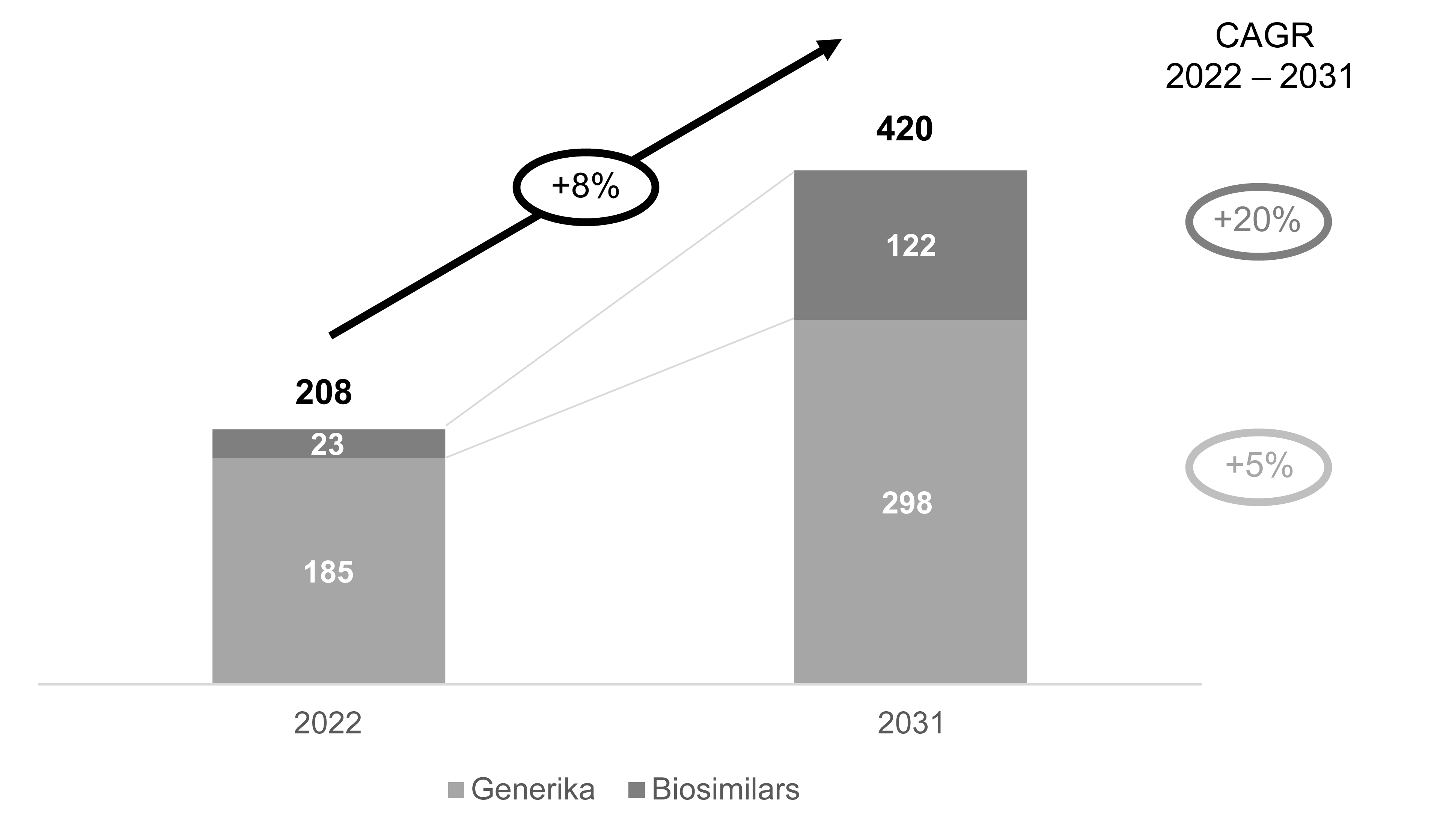
Overview of the generics/biosimilars market
The market for off-patent medicines is currently estimated at gross revenue of around 208 billion USD and is expected to grow by around 8% p.a. over the course of the next decade. Growth in the emerging market for biosimilars will be considerably higher. There is thus a huge market opportunity for blockbuster drugs whose patent protection expires in this decade. Sandoz puts this opportunity at more than 260 billion dollars for the 2023–2027 period alone.
The following drivers influence the future growth of the market for off-patent medicines:
Positive:
- Growing and ageing population
- Increasing prevalence of chronic diseases
- Rising costs in the healthcare system
- Upcoming cycle of blockbuster drugs whose patent protection is expiring
- Increasing market acceptance of generics and biosimilars
Negative:
- Persistent price erosion for generics/biosimilars
- Changes in the patent landscape, above all with regard to patent extensions
Sandoz is among the leading generics/biosimilars manufacturers worldwide. Some competitors such as Teva or Viatris do not focus exclusively on the business of drugs whose patent protection has expired.
Source: The Generics Bulletin, Keynote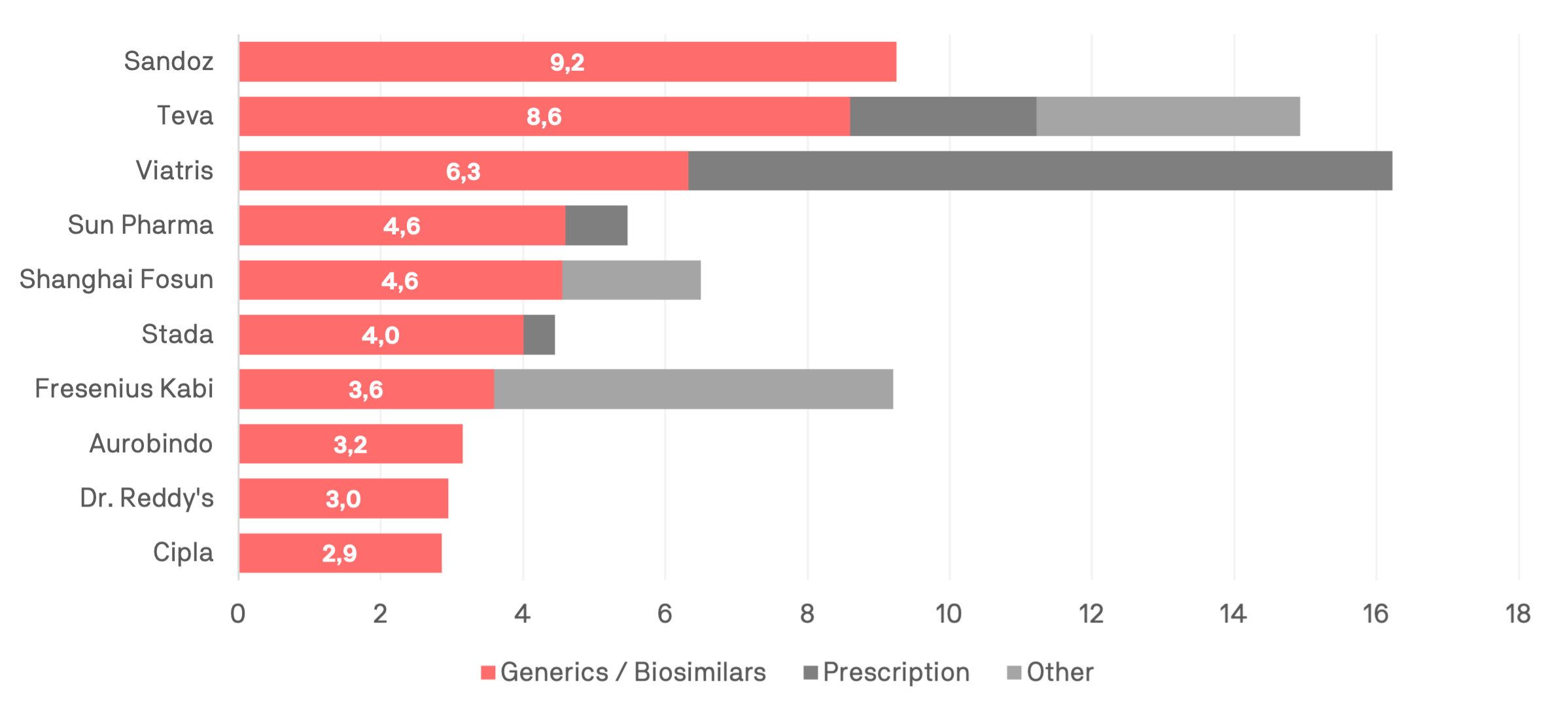
The profit margins in the biosimilars business are about 20% higher than for conventional generics. This premium is justified, since the investments are considerably higher and the development time is substantially longer. This has kept competition relatively low, which makes the market for biosimilars comparatively attractive relative to simple generics for developers that have the resources and the expertise to succeed in this area. In contrast to generics, where price often determines market success, for biosimilars quality and availability are decisive. This is precisely Sandoz's strength.
Spin-off checklist: what do the key spin-off indicators say?
Spin-offs are always special situations. Over the past decades, the following scientifically studied indicators have proven relevant for the assessment of spin-offs:
- Understanding the reasons for the spin-off
- Ruling out excessive indebtedness
- Ruling out problematic assets/litigation
- An «internal» CEO
- Incentivisation of management
- Low analyst coverage
- Insider buying
In the specific case of Sandoz, these indicators can be assessed as follows:
1. Sensible reasons for the spin-off?
The spin-off of Sandoz from Novartis brings with it the usual advantages associated with spin-offs:
- Focus: Novartis and Sandoz can concentrate their resources and efforts more specifically on those areas where they see the greatest growth opportunities, without being impaired by the concerns of the other company.
- Sandoz: creation of a leading company for off-patent drugs, focused on generics and biosimilars.
- Novartis: further transformation of Novartis into a focused company for innovative medicines.
- More efficient capital allocation: capital can be allocated better to the respective investment priorities. A capital structure that corresponds to the respective cash flows and growth profiles can be implemented.
- Incentivisation: clearer alignment of incentives with performance targets.
- Differentiated investment profile: Sandoz as a generics and biosimilars company, and Novartis as an innovative drug manufacturer, will have a clear profile. The separation will offer investors two distinct and targeted investment opportunities.
However, negative effects must also be taken into account. The spin-off brings certain «dissynergies» for Sandoz:
- Sandoz can no longer access Novartis's global IT infrastructure.
- Sandoz will continue to depend on Novartis for certain production processes. However, an agreement has been reached for this.
- Sandoz will have a lower capital base and will have to reckon with higher capital costs.
- Vis-à-vis partners such as regulatory authorities or business partners (suppliers, customers), Sandoz will have lower bargaining power. However, Sandoz intends to focus on considerably fewer suppliers (higher volumes in exchange for better prices).
In connection with the spin-off from Novartis, various special expenses arise that will amount to 500 to 600 million USD in total. 2023 in particular will prove to be a transitional year: around 200 million USD will be charged to the current financial year.
Although Novartis and Sandoz are both pharmaceutical companies, their businesses are nonetheless very different. The following characteristics support the view that Novartis and Sandoz can develop better in the market as independent companies:
Die wichtigsten Unterschiede zwischen den Geschäftsmodellen
Innovative Arzneimittel | Generika | Biosimilars | |
|---|---|---|---|
Klinisches Verfahren | Mehrere Stufen | Keine | Wirkungsnachweis |
Zulassungshürde | Sehr hoch, Wirkung muss besser als Therapiestandard sein | Sehr tief, da genaue Reproduktion des aktiven Inhaltsstoffes (API) | Höher als bei Generika, da Wirkung des APIs nachgewiesen werden muss |
Preisdruck | Gering (20 Jahre Patentschutz ab Zulassung) | Sehr hoch, 85% über Grosshändler (USA) | Weniger Einfluss von Grosshändlern, da nicht beliebig austauschbar |
Entwicklungskosten | rund 1.3 Mrd. USD | rund 1 bis 2 Mio. USD | 100 bis 300 Mio. USD |
Markteinführungszeit | 12+ Jahre | 2 Jahre | 7 bis 9 Jahre |
Markteinführungsrisiko | Sehr hoch | Sehr tief | Moderat |
Quelle: Unternehmensdaten, Sandoz, Drug Channels Institute
The two business models (innovative medicines vs. generics/biosimilars) are very different: whereas at Novartis the majority of resources are spent on the discovery and development of novel drugs, at Sandoz it is above all about optimising the production processes and replicating active ingredients as quickly and in as good a quality as possible. Substantial differences can also be found in the customer base (at Novartis often via health insurers, at Sandoz wholesalers), in the consistent pursuit of patent disputes, or in dealings with the authorities (different approval procedures).
Given these differences, differing business models and value drivers, it makes sense for Novartis and Sandoz to position themselves as independent companies.
2. Appropriate indebtedness?
Several studies have shown that too high a debt burden is one of the main reasons for disappointing or even failed spin-offs. This naturally depends on the cash generation of a spin-off – but a net debt/EBITDA ratio of 3x appears to represent an important upper limit.
According to its own figures, Sandoz will have a net debt/EBITDA of below 2.0x to 2.5x at the spin-off. Given the free cash flow generated (2022: 0.83 billion USD, incl. inventory build-up costs post-COVID), this points to a solid financing structure and leaves Sandoz sufficient room to make the necessary investments.
3. No problematic assets/litigation?
The litigation connected with the opioid crisis in the US has expanded beyond the original culprits, i.e. Purdue Pharma and the Sackler family. A broad spectrum of actors, ranging from medical distributors to generics manufacturers, is now expected to pay billions of dollars in order to settle the claims of thousands of local, municipal and state authorities as well as various other plaintiffs. The generics manufacturers Teva and Allergan could be obliged to make settlement payments of up to 4.5 billion USD and 2.0 billion USD respectively.
Although Sandoz is likewise involved in such litigation, Sandoz's role in these disputes can be classified as considerably smaller, and it may be assumed that the sums to be paid will turn out to be much lower. The «offloading» of litigation can therefore be ruled out as a motivation for the spin-off.
4. An «internal» CEO?
Research has shown that an «internal» CEO (i.e. a CEO who previously led the business unit within the parent group) represents a positive aspect for the development of the spin-off.
The CEO at Sandoz will be Richard Saynor. He is a trained pharmacist and possesses extensive experience in the pharmaceutical industry, both at innovation-driven and at generics/biosimilars companies. He was appointed CEO of Sandoz in 2019. Before joining Sandoz as CEO, he was Senior Vice President for Classic & Established Products, Commercial & Digital Platforms at GSK. Before that, he held various commercial leadership positions at Sandoz.
As head of Sandoz within the Novartis group, he must have had a hard time making himself heard. The innovative medicines business generates higher margins and requires large sums for the research and development of novel drugs. Accordingly, it may be assumed that the generics/biosimilars business was somewhat neglected within the group. He ought to know where the «low-hanging fruit» is to be found and how it can quickly be converted into higher profits.
5. Incentivisation of management?
Although not all details on the incentivisation of management are yet known, it may be concluded from the information in the prospectus that the interests of management are aligned with those of shareholders:
- In addition to the base salary, the CEO receives an annual performance incentive based on Sandoz's financial targets (net revenue, operating result and free cash flow as a percentage of revenue).
- From the date of the spin-off, the annual incentive targets of the members of the executive committee, expressed as a percentage of base salary, will be increased in order to reflect the promotion to the executive committee of an independent, publicly listed Swiss company.
- A performance-linked component (Performance Share Units, which can be converted into Sandoz shares) that takes into account Sandoz's operating development between 2024 and 2026.
- The CEO is to build up a shareholding in the company amounting to three times the annual base salary (for the other members of the executive committee, a shareholding amounting to twice the annual base salary). In addition, the CEO and the CFO are obliged to hold the shares exercisable under the remuneration plan for at least two years from the exercise date.
6. Low analyst coverage?
Given the size of the spun-off company (leading generics/biosimilars manufacturer worldwide with revenue of 9.3 billion USD) and a long tradition in Switzerland, some analysts will (have to) take up coverage from the spin-off onwards. On the other hand, there is likely to be a change among the health care sector analysts. Until now, Sandoz was covered primarily by the analysts who covered the pharmaceutical sector and Novartis. In future, Sandoz (outside Switzerland) will probably be followed for the most part by those analysts who cover the generics sector and thus companies such as Viatris or Teva. Accordingly, it is entirely possible that the view of Sandoz will over time turn out somewhat more positive than is the case among the pharmaceutical analysts. Neglect by the analyst community is not to be assumed. However, it is entirely possible that the pharmaceutical analysts will misclassify Sandoz's business model, because:
- Traditional pharmaceutical companies (Big Pharma) generate higher margins, but also have to bear higher capital requirements and high development risks.
- Generics manufacturers did indeed exhibit poor share-price performance from 2015 onwards (price pressure through consolidation of the buyers, excessive valuation, litigation), but this is now likely to change thanks to biosimilars and better pricing.
- The poor balance sheets of the generics manufacturers are improving increasingly. The Sandoz competitor Viatris, for example, generated an FCF of 2.5 billion USD in each of the years 2021 and 2022. For 2023 an FCF of 2.3 billion is being forecast, even though Viatris plans to divest assets in the order of 5 to 6 billion USD. Signs are mounting that the market is stabilising and, from 2023 onwards, turning towards growth. The chances are thus good that the sector's returns on capital will improve and that capital allocation in the coming years will move from debt reduction towards share buybacks.
7. Do insiders buy shares in their own company?
Several studies have shown that insider buying represents a very positive sign for the future share-price development of a spin-off. However, management's purchases will only become visible from the spin-off date (4 October 2023).
Conclusion: 5 out of 7 indicators paint a promising picture for the spin-off of Sandoz (no information yet on insider buying). Nevertheless, much depends on the price at which the Sandoz shares trade on the first day of trading and whether this price is attractive.
Is the Sandoz share attractive?
Within Novartis, the generics subsidiary was the problem child that diminished growth and profit margins. Indeed, Sandoz has had to record a decline in revenue every year since 2016. Yet this downward slide is likely to come to an end soon, and 2023 is set to be the first year in which the company will generate growth again.
Sandoz's forecasts envisage revenue growth in the «mid single-digit range» for the period 2023 to 2028. This appears low given the scale of the expiring patents and Sandoz's strong market positioning in biosimilars. Interestingly, every competitor of Sandoz sees a turnaround in revenue growth over the period from 2023 to 2028. It is thus quite possible that Sandoz's management is being rather conservative here. Sandoz already achieved revenue growth of 8% in the first half of 2023, which implies that in the second half only revenue growth of 2% would be achieved.
With regard to margins too, the medium-term targets set could be of a rather conservative nature, since biosimilars have around 20% higher margins than simple generics. At the end of 2021, biosimilars accounted for 21% of revenues. Given the forecast growth, this share will rise to more than 30 to 35% by 2028, with correspondingly positive effects on margins.
Against the backdrop of the poor sentiment towards the generics industry, investor sentiment has reached a low point, which is reflected in the very low valuations of the industry. The combination of declining revenues and a high level of indebtedness (4.0x at the median) has resulted in the peer group being traded, at the median, at multiples of only 1.97x EV/Sales, 6.08x EV/EBITDA, and a P/E of 3.8x (see table below). Some of Sandoz's competitors exhibit higher margins because, alongside the generics business, they also rely on branded products and innovations.
Source: Bloomberg, Keynote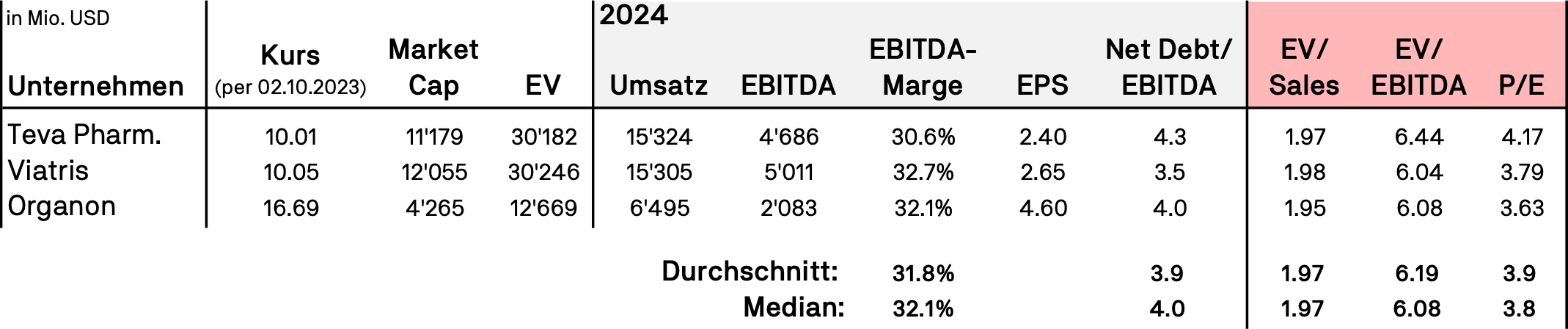
- Sandoz expects gross indebtedness of 3.75 billion USD and a cash balance of 670 million USD. That corresponds to net indebtedness of 3.08 billion USD.
- On the basis of the forecasts for 2023, EBITDA is likely to amount to 1.75 billion USD and FCF to 840 million USD.
- This puts net indebtedness at 1.8x on an EV/EBITDA basis and at 3.7x in relation to FCF.
It may be assumed that Novartis is convinced of Sandoz's business model and its growth prospects as a standalone company, and that the fair debt ratio is intended to enable Sandoz to make a good start into freedom.
Sandoz is attractive if the communicated targets are achieved:
- Revenue growth in the mid single-digit range from 2023 to 2028 (including 2023 vs. 2022).
- Expansion of the EBITDA margins from 18–19% in 2023 to 24–26% by 2028.
- Increase of the FCF conversion from 48% of EBITDA in 2023 to 70% by 2028.
The table below reflects the guidance of Sandoz's management. On this basis, Sandoz will generate an FCF of 840 million USD, or 1.95 USD per share, in 2023 (with a share count of 431 million after the spin-off). By 2025, the FCF per share is likely to rise by more than 50%; by 2028, the FCF per share will increase two-and-a-half-fold to more than 4.93 USD per share.
Source: Unternehmensdaten, Keynote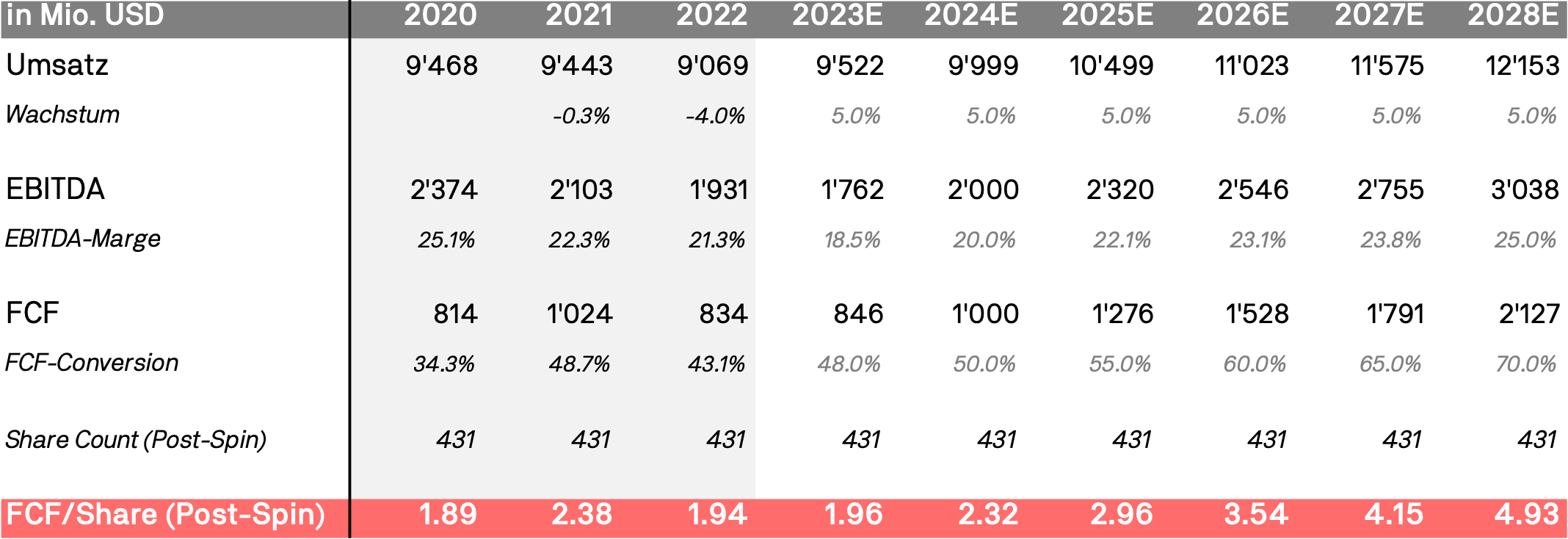
13.0 billion enterprise value (EV)
less 3.08 billion USD net indebtedness
= equity value of 9.92 billion USD, or 23.00 USD per share (21.16 CHF)
At the peer group's valuation multiples, Sandoz would be attractively valued with an FCF yield of 10%. At a valuation premium (EV/EBITDA of 8x), this would correspond to a value per share of around 30 USD, or 27.60 CHF. There are not many large-cap companies in the market with such attractive valuations that at the same time aim to increase FCF two-and-a-half-fold over the coming five years. Owing to its low indebtedness, Sandoz – in contrast to its competitors – would thus also quickly be in a position to buy back its own shares or distribute dividends.
An alternative way of looking at it is offered by what is known as total return decomposition, in which the individual components of a share's total return are considered separately. On the assumption that Sandoz achieves the FCF targets as per the table above, the following picture emerges:
Source: Bloomberg, Keynote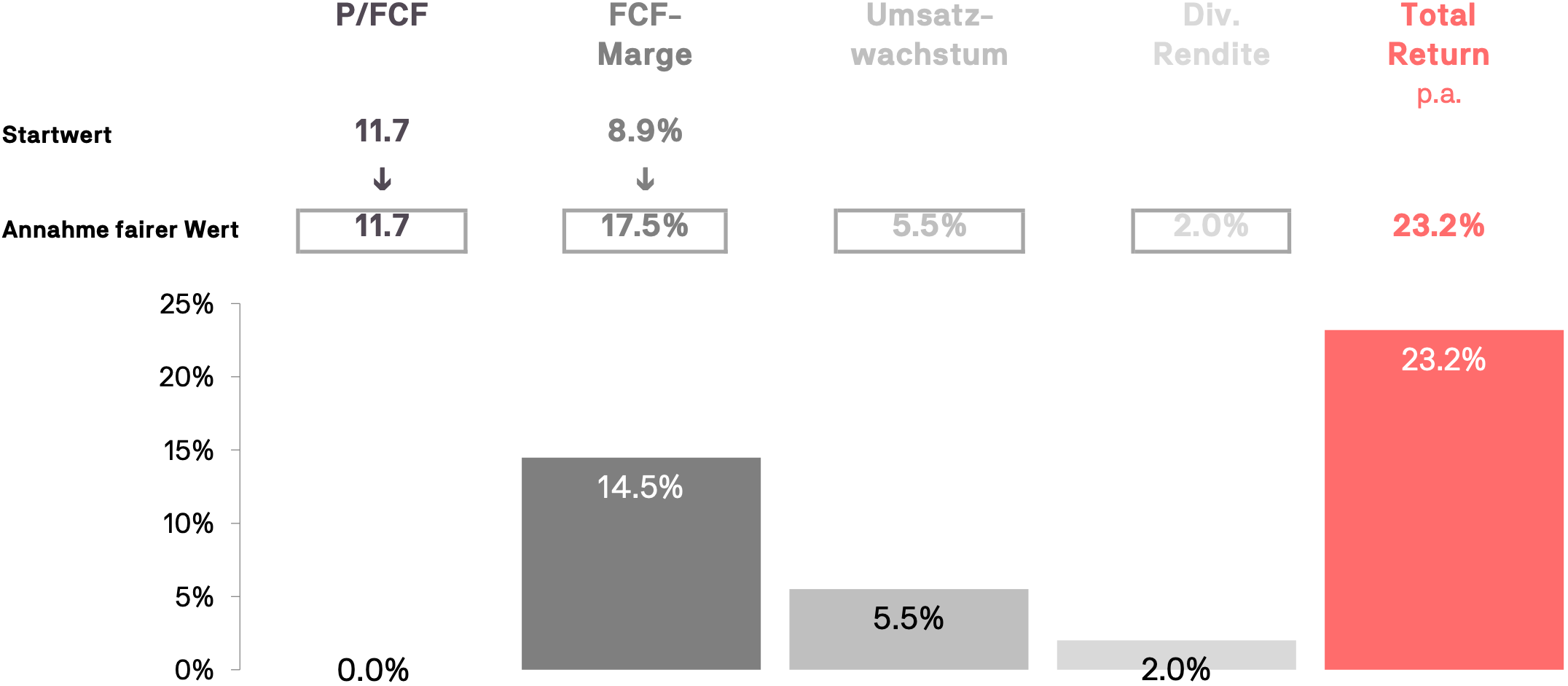
In aggregate, this results in an attractive total return of 23.2% p.a. If this growth is applied to a share price at the start of 21.16 CHF, then a price potential of around 61 CHF would result by 2028. However, it would be unusual for Sandoz not to be rewarded by the stock market with a valuation expansion upon achieving the growth and margin targets.
The consideration also clearly shows that the majority of the expected total return comes from the margin expansion, and that it will therefore be of central importance for the medium- to long-term development of the Sandoz share price that management can indeed realise the operating margin targets.
Selling pressure after the spin-off
In a spin-off, shares of the spun-off company (Sandoz) are distributed to the shareholders of the parent company (Novartis). For every five Novartis shares, shareholders receive one Sandoz share in the form of what is known as a stock dividend. Any fractions will be paid out not in the form of shares but in cash.
In the first weeks of trading, selling pressure and correspondingly falling prices for Sandoz must be expected. This is not unusual for spin-offs, but corresponds to the normal «spin-off mechanics» that have been evidenced by several studies: in the first 3 to 6 months after the spin-off, spin-offs perform worse than the overall market.
This must also be expected in the case of Sandoz, since the following investors are likely to / must dispose of the shares:
- Private investors: Novartis is a stock popular among private investors. This has various reasons, such as the history, the size, the importance of the company and the attractive dividend yield. It may be expected that many private investors who hold Novartis shares will be little enthused by Sandoz and will accordingly dispose of the allocated shares after the spin-off.
- ETFs/passively oriented institutional investors: Investors who track the SMI as reference index will have to dispose of the allocated shares. This effect will probably be partly mitigated by those passive investors who use the SLI or SMIM as reference index and therefore have to buy shares. Overall, however, selling pressure is likely to come from these investors too.
- ADR holders: Selling pressure is also to be expected from the Anglo-Saxon world. In this region, Novartis shareholders are frequently invested via American certificates (ADRs). In contrast to Novartis, the Sandoz ADRs are not listed on a US exchange, but are instead traded over the counter. It is estimated that between 9% and 10% of the Novartis shares are held as ADRs, and it must be assumed that around half will have to dispose of the Sandoz ADRs.
Conclusion: many factors point to an attractive spin-off situation
Sandoz has many of the ingredients for a successful spin-off. The generics market has been difficult in recent years, and Sandoz has recorded declining revenues since 2016. The competing firms are plagued by high indebtedness, and correspondingly high is the scepticism, which results in low industry valuations. Yet the market for generics/biosimilars will record growth again from 2023 for the first time. With a strong balance sheet and its excellent market position in the area of biosimilars, Sandoz is well positioned to benefit from this. The targeted growth objectives with regard to revenue, margin and FCF development are not seen so often at a supposedly cumbersome and shrinking company. The chances are therefore good that these targets will in the end even prove to be too conservative. Ultimately, then, it comes down to the price at which the Sandoz shares are traded. Should one be able to obtain Sandoz at valuations similar to those of the listed competitors, the shares would be a clear buy.