Indicators of attractive spin-off situations
Find out what to pay particular attention to when assessing spin-offs, which indicators point to attractive spin-offs and which spin-off situations are attractive.
Published onReading time 17 minutes

In the first part of the Keynote Insight series on spin-offs we set out what spin-offs are, for what reasons they are carried out and why the special spin-off «mechanic» opens up attractive investment opportunities. In addition, we addressed the substantial scientific evidence, which consistently confirms that spin-offs achieve above-average returns. This second part of the Keynote Insight series examines what to pay particular attention to when assessing spin-offs, which indicators point to attractive spin-offs and which spin-off situations are attractive.
When analysing a business model, significant competitive advantages, high returns on capital and a solid balance sheet play a central role. Combined with an assessment of management, the valuation and sustainability risks, a picture of a share's attractiveness emerges. These criteria also apply to spin-offs. However, spin-offs always represent special situations with specific idiosyncrasies: this gives rise to challenges, but also opportunities, in the analysis.
Understanding the reasons for a spin-off
When assessing the attractiveness of a spin-off, it is essential to understand the motives behind the separation. Normally there are one or more reasons why a company wants to split into two or more parts. As a rule, the valuation discount plays a role (the sum of the individual parts is worth more than the company's current share price). Below-average performance relative to the peer group and the overall market (both operationally and in terms of the share price) is often another reason for a spin-off. In many cases the pressure then comes from outside and brings activist shareholders onto the scene.
While the conglomerate discount and share-price underperformance are two important aspects for a spin-off, the management team and the board of directors should consider a whole range of factors:
Is there a conglomerate discount?
When a company consists of two or more business divisions, it is likely that a «sum-of-parts discount» exists. Are the two (or more) business divisions being managed optimally within the conglomerate? If this is not the case, the question arises as to whether the business can best be optimised over the long term inside or outside the group. Often a valuation discount exists because the parent company is a «mixed-goods store» with business divisions from different industries, between which there are few synergies and whose true value is lost within the conglomerate. Investors prefer «pure plays», as a focused company can be assessed more easily. In many spin-off situations there is one business division that is growing very strongly within the group and another that is more mature and barely growing, if at all. Very often the latter is the «cash cow» that helps to finance the capital expenditure, mergers and acquisitions in the fast-growing business division.
Can the spun-off company flourish outside the parent company?
Business divisions within a conglomerate often differ considerably in terms of growth prospects and profit margins. For the slow-growing and/or less profitable business division, the situation within a conglomerate is often difficult. Frequently this division receives little attention and, correspondingly, not its fair share of investment to increase market share, invest in research and development and make acquisitions. Talent within the company often moves internally to the more dynamic or more profitable business division, as the latter generally receives more attention and its employees a larger share of the bonus pool. Moreover, it is likely that any new CEO would be recruited from a different business division.
While the short-term success of spin-offs has a great deal to do with the disappearance of the conglomerate discount, for medium- to long-term success it is far more decisive whether the spun-off business division receives the resources, capital and talent that it lacked within the conglomerate. When a company is set free, there are often plenty of interesting projects with high returns on capital that should already have been tackled within the conglomerate and can be realised in the first one to two years after the spin-off: from launching new products, consolidating factories and focusing marketing efforts to cost savings and value-accretive acquisitions. If the management team comes from within, motivation to work at the spun-off company also increases. As a separately listed public company, the spin-off is responsible for its own destiny and is no longer treated as a «second-class passenger» within the conglomerate.
Does a sale make more sense than a spin-off? Or does an equity carve-out, a split-off or a Reverse Morris Trust make more sense?
If a company has the critical size (see next point), a spin-off is generally more sensible than a sale, since a spin-off is in most cases structured as a tax-free transaction, whereas a sale in most cases entails tax consequences. Essentially there are only two aspects under which a sale is preferable to a spin-off: 1) a buyer is willing to pay a higher price (after tax) than the spin-off would generate for shareholders over the medium term, or 2) the parent company has too much debt and must divest a business division in order to reduce the debt and thereby improve the balance sheet. In all other situations, the spin-off allows existing shareholders to participate in the spin-off's upside potential in a tax-efficient way.
If the parent company's debt burden is too high, an equity carve-out can be a sensible transaction. In a carve-out, the parent company sells part of its stake in the subsidiary to the public via an IPO, whereby the subsidiary becomes a standalone company. In the USA, parent companies are able to sell up to 19.9% of their shares in a newly formed corporate entity tax-free, before a full spin-off then takes place at a later date. A split-off takes place only when the parent company has previously listed a business division on the stock exchange. The advantage of the split-off is the fact that it gives the parent company's shareholders a certain degree of discretion as to whether they wish to hold shares in the parent company and the new company, or whether they wish to part with the parent company and hold only shares in the new company. Another spin-off variant is a so-called «Reverse Morris»-transaction. Here a business division or other assets are hived off into a separate company and then merged (tax-free) with another company.
Does the spin-off have the critical size?
A separate listing as a public company is not free and can incur annual costs of USD 5 million or more. Spinning off a business worth USD 50 or 100 million generally makes little sense. Here a sale would probably be more sensible. Indeed, studies have shown that micro-cap spin-offs tend to underperform.
Does the spin-off harm the customers of either company?
Are the goods and services of the parent company and the spin-off bundled, or do competitors bundle their goods and services, such that a separation would negatively affect the competitive position of the new spin-off company? Are the products and services offered through a shared sales force, such that staff would have to be doubled if two public companies existed? A spin-off makes no sense if both the customers and the competitive position of the two companies are negatively affected.
How large is the difference between the individual business divisions?
As a general rule: the greater the difference between the individual business divisions in terms of industry affiliation (lack of synergies), cyclicality, growth rates, margins, capital intensity and ultimately the expected shareholder base, the greater the urgency to separate the business divisions. Indeed, studies have shown that those spin-offs perform particularly well which originate from a conglomerate organised into more than three different business divisions (often from different industries).
High debt and problematic assets as red flags
As shown in the first part of the Keynote Insight series on spin-offs, spin-offs exhibit a high dispersion in share-price performance. This means that the «good» spin-offs achieve significantly better performance than the «bad» ones. «Bad» spin-offs are often burdened with a high debt load or problematic assets/litigation.
Naturally, even «bad» spin-offs are described by the parent company's management as «strategically sensible», since a company does not wish to be branded as one that simply «disposes» of its problems in a spin-off. Negative headlines are to be avoided. So how should one attempt to identify the «bad» spin-offs and screen them out early?
The debt that the spun-off company takes on is apparent from the published data on the spin-off. A high debt burden is especially problematic when the spun-off business generates low free cash flows and a rapid repayment of the borrowed capital therefore appears unlikely.
Intuitively it makes sense that a high debt burden leads to poor returns in spin-offs: because the debt must be repaid, the company cannot make important investments, cannot advance research and development as desired and must use a high share of any potential profit to service interest and repay debt (= fewer dividends, no share buybacks). This conclusion is confirmed by several studies that have examined the relationship between high debt at the time of the spin-off and the subsequent return of spin-offs. How much debt a company can bear depends not least on the business model. In principle, however, a ratio of net debt to operating profit (net debt / EBITDA) of 3x appears to serve as the upper limit.
Component could not be found for blok RichTextCaseStudy! Is it configured correctly?
The question of problematic assets is more difficult to clarify and can only be addressed through media research and the analysis of potential reputational risks. In any case, it is essential to recognise the true motives of a spin-off and to examine the company accordingly for possible lawsuits and reputational risks.
Spin-Offs mit problematischen Vermögenswerten - Historische Beispiele
Spin-Off | Mutter- gesellschaft | Branche | Überlegung | Probleme | Resultat |
|---|---|---|---|---|---|
Tronox 2005 | Kerr-McGee | Energie | Fokussierung auf Exploration und Abspaltung des Titanium Dioxid-Geschäfts | Klagen gegen Tronox wegen Umweltverschmut-zung an verschiedenen Standorten | Aufgrund der Klagen meldete Tronox 2009 Konkurs an. Kerr-McGee wurde 2011 wegen betrügerischer Absicht beim Spin-Off zu einer Busse von USD 5.2 Mrd verurteilt und von Anadarko Petroleum übernommen (2014). |
California Resource Corp. 2014 | Occidental Petroleum | Energie | Separierung der kalifornischen Vermögenswerte | Strenge Umweltvorschriften in Kalifornien, Vermeidung von Kosten und Verbindlichkeiten kontaminierter Standorte | Rechtsstreit bzgl. Verschmutzung und Bussen wegen Verstösse gegen Umweltgesetze führten letztlich zur Konkursanmeldung 2020 |
Chemours 2015 | DowDuPont | Chemie | Konzentration auf Spezialitäten-Chemie und Ausgliederung des Commodity-Geschäts | Umweltverschmutzung durch PFC (krebserregede, nicht abbaubare Chemikalien, welche v.a. bei Pfannenbeschichtungen, wasserdichter Kleidung, etc Anwendung finden). | Sämtliche Umwelt- und Rechtsverbindlichkeiten bezgl. PFC wurden an Chemours übetragen. Die wissentliche Verschmutzung von Flüssen mit PFC führten 2021 zu einem Vergleich von USD 4 Mrd. |
Quelle: Keynote
As the examples presented illustrate, contingent liabilities arising from problematic assets, litigation and lawsuits often lead, alongside the reputational damage, to insurmountable financial burdens for the spun-off company.
Once one understands the reasons that have led to the spin-off of a business division and can rule out the offloading of debt or contingent liabilities onto the spun-off company, it is essential to assess the prospects of future business development. Spin-offs are special situations and therefore exhibit particular characteristics that should be carefully considered in the analysis. Of the many indicators examined, the following appear to point especially strongly to a promising price development in spin-offs:
- Spin-off from a conglomerate
- Incentivisation of management
- «Inside» CEO
- Low analyst coverage
- Insider buying
1. Spin-off from a conglomerate: when 1+1 becomes >2
A conglomerate is a company with various units under a common roof and common leadership. Conglomerates typically arise when companies diversify their activities by acquiring different business divisions, in order to offset economic fluctuations or to enter more profitable, higher-growth sectors. In most cases there are few or no synergies at all between the operating units in a conglomerate. Although conglomerates are usually large companies, there are certainly also smaller and mid-sized companies that have positioned themselves in this way.
Academic research has confirmed that the valuation of diversified companies is subject to a «conglomerate discount». The discount can be calculated by comparing the value of the company with the sum of the values of each individual segment: if the sum of the parts is worth more than the whole, then a conglomerate discount exists. Empirical studies show that conglomerate discounts in developed markets typically range between 5% and 15%.
The following causes can explain such a conglomerate discount:
- Disadvantageous resource allocation: Companies have a limited amount of capital and resources that they can deploy on projects. While some may offer an attractive return and create value over time, they may have to be forgone in favour of more urgent uses of capital in other segments.
- Management capacity: With several business divisions, management cannot focus as a priority on improving and growing each division. In addition, different divisions demand different skills and know-how from management.
- Disadvantageous incentives: In conglomerates, management is to a greater extent remunerated according to the company's overall performance and not according to the results of the individual business divisions. This can be a demotivating factor when one's own remuneration depends on the performance of other managers/divisions.
- Market preference: Financial investors prefer, when allocating their capital, to construct their own diversified corporate portfolios using «pure play» companies.
To avoid the conglomerate discount, companies essentially have two options: either they demonstrate that they have capital allocation and the distribution of resources continuously under control, so that the company suffers no disadvantages from its numerous business units. Or they reduce the number of business units. Since the former is considerably more difficult and demanding than the latter, it is not surprising that the divestment or hiving-off of a business unit is often pursued in order to reduce the valuation discount on the stock exchange.
Empirical studies show that reducing the conglomerate discount is one of the main reasons for the observed outperformance of spin-offs. The chart below summarises the results of a study by JPMorgan that analysed the valuation expansion following the hiving-off of business units via a spin-off: on average, companies experienced a valuation expansion after the spin-off from an original 6.9x EV/EBITDA to 8.3x (weighted average of parent company and spin-off).
Source: JPMorgan, Keynote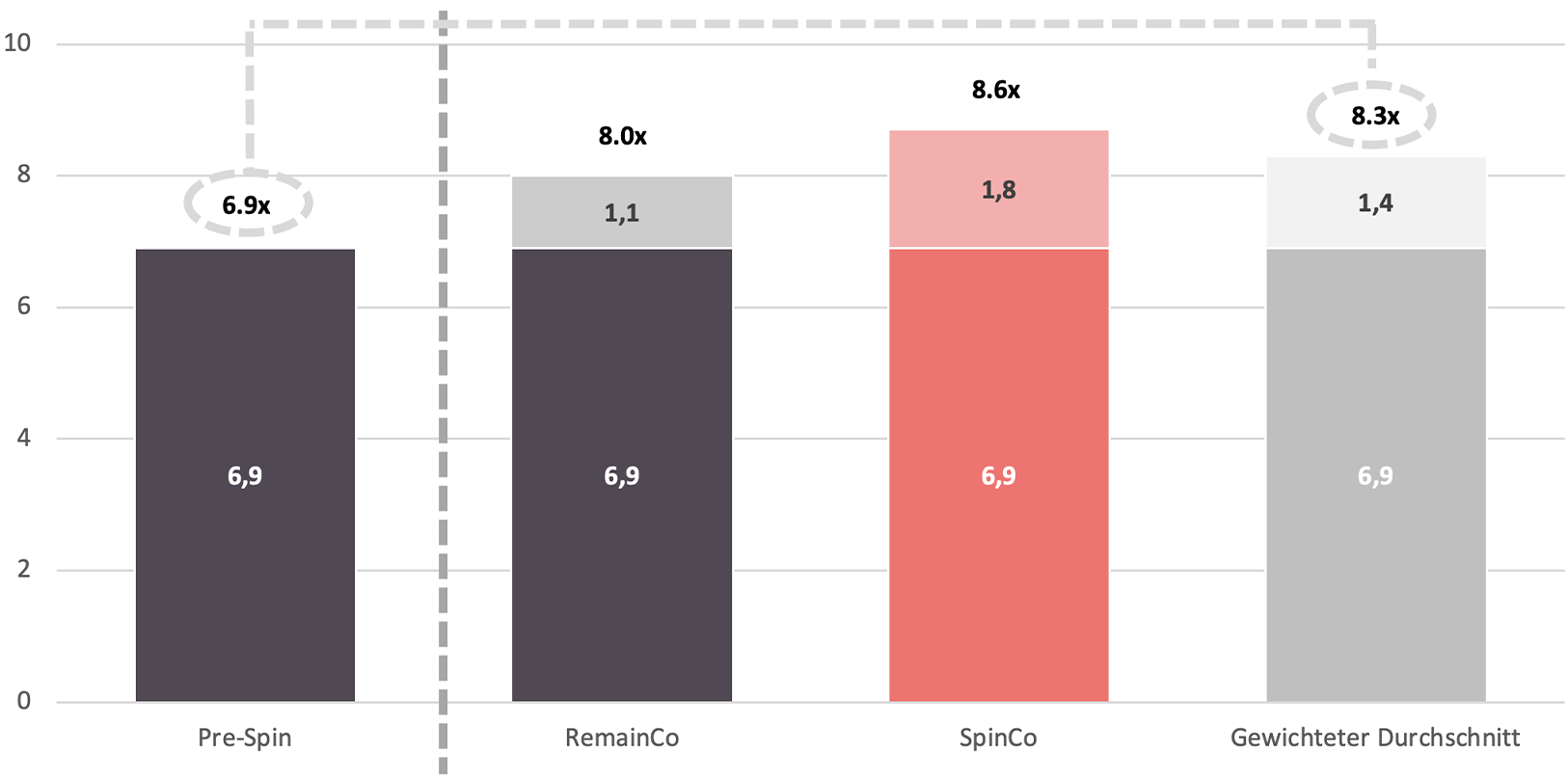
2. Incentivisation of management: shareholders and management aligned
In spin-offs, the management of the spun-off company is often incentivised with shares and/or options. The aim is to ensure that the interests of the shareholders are the same as those of management. If a large part of management's remuneration consists of such incentivisation, then this ensures that management pursues the same goals as the shareholders – namely, the most positive possible price development of the new company. Studies suggest that a substantial part of the outperformance that spin-offs achieve over 1 and 3 years is attributable to this factor. It is certainly worthwhile examining the incentive structure for the management team closely, in order to focus as far as possible on those spin-offs in which the interests of management and shareholders are aligned.
It is also interesting to note that, at the time of the new listing, management has no interest in communicating the merits of the spun-off company to market participants. Unlike in an Initial Public Offering (IPO), in the case of a spin-off no funds flow to the parent company: the shares of the spun-off company are distributed to the existing shareholders. In an IPO, the company's prospects are praised to the skies: detailed analyst reports are produced by the investment banks, highlighting the incredible potential of the IPO. In spin-offs almost the opposite is the case: management has no incentive to make the first price quotation high. Since the value of their share and option packages is based on the appreciation of the share price, they even have, on the contrary, an interest in the price being set as low as possible at the outset. It is not unusual for the new management to comment either not at all, or only very cautiously, on the prospects of its own company before or shortly after the spin-off.
Component could not be found for blok RichTextCaseStudy! Is it configured correctly?
3. «Inside» CEO: harvesting the low-hanging fruit
Alongside the quality of the business model, the assessment of the management team is of central importance in general company analysis. In spin-offs it is often pointed out that the separation contributes to the focus of both companies and reduces complexity. If, for example, a conglomerate operates in various business divisions that exhibit different success factors, regulatory requirements and competitive situations, this complexity can overwhelm the management team and lead to below-average results. It is therefore self-evident that reducing the complexity at the parent company by hiving off a business division can free up management capacity, and that this focus leads to better results. But what about the spin-off?
In the spin-off, too, management capacity is freed up, since the CEO no longer has to make himself heard within the conglomerate or fight for financial or human resources. From the spin-off onwards, he can concentrate exclusively on his own business and deploy the financial and human resources as he sees fit, where he identifies the greatest chances of success.
Studies have shown that spin-offs led by «internal» CEOs exhibit better performance. An «internal» CEO is a corporate leader who previously spent many years at the parent group and ideally led the spun-off business division within the company. Such CEOs know where the low-hanging fruit is to be found, and where they need resources that the parent company had not previously made available to them.
At the same time, it was found that a new, «external» management team tends to lead to below-average results: the managers do not really know the new company they are running and lack the relationships and the institutional knowledge to make well-founded decisions. So in spin-offs the rule is: an experienced management team familiar with the spun-off company increases the chance that the spin-off company will develop positively.
Component could not be found for blok RichTextCaseStudy! Is it configured correctly?
4. Low analyst coverage: low interest and difficult information gathering
One of the most important reasons why most investors give spun-off shares a wide berth, despite the promising scientific evidence for the outperformance of spin-offs, lies in the difficult information situation. In spin-offs, often only sparse financial information about the spun-off business is published – detailed financial metrics are not available. In addition, the figures often go back only two or three years, which makes the identification of growth trends or margin development more difficult.
Moreover, coverage by financial analysts is rather low, meaning analyst reports are not available. Since the spun-off company is usually smaller than the parent company, covering it with an analyst is no immediate priority. In addition, the spin-off is often assignable to a different industry, one that does not fall within the remit of the parent company's analyst. Companies are, admittedly, accompanied by investment banks in spin-offs. Unlike in Initial Public Offerings (IPOs), the banks do not earn high sums through the spin-off, since it is not a sale but a «free distribution» to the parent company's shareholders. Thus the incentive to present the attractiveness of the hived-off company by means of comprehensive studies is absent. Ultimately, therefore, the bank analysts have little interest in initiating «coverage»: no additional revenues but more work is rarely a recipe for high engagement.
When over 60 analysts track a large company at every turn and try to be the first each time to obtain additional information, then one can assume that all available information about this company is already priced into the share price. Spin-offs, by contrast, are less thoroughly scrutinised. Thus we are dealing with an inefficient area of the equity markets.
On a median basis, spun-off companies have in recent years been tracked by no more than three analysts after the separation. Studies have shown that spin-offs tracked by no analysts or only very few analysts deliver better returns. The difficulty of gathering information is therefore at the same time also a source of above-average returns in spin-offs.
Component could not be found for blok RichTextCaseStudy! Is it configured correctly?
5. Insider buying: institutional investors don't want the spin-off, insiders do…
The successful portfolio manager Joel Greenblatt also prominently mentioned spin-offs in his book «You can be a Stock Market Genius» and described what he pays particular attention to when selecting successful spin-offs: «Institutions don't want it; Insiders buy it». Institutional investors such as large pension funds or passively oriented investment vehicles like ETFs are in most cases not allowed to continue holding the spun-off share in their portfolio and therefore sell the spin-off. This is one of the most important reasons why the shares of spin-offs often exhibit disappointing price development in the months after the separation. This special «spin-off mechanic» was already described in the first Keynote Insight on the subject of spin-offs.
When corporate leaders buy shares in their own company, this indicates that they are convinced of their company's prospects and want to make money from them. Joel Greenblatt's statement therefore makes intuitive sense: spin-offs in which management buys its own shares should be examined more closely.
Scientific studies prove that shares of companies with high insider buying represent rewarding investment targets – especially in the case of spin-offs. They confirm Joel Greenblatt's intuitive logic. A study of 817 spin-offs by the University of Chicago from 2001 found that spin-offs bought by insiders after the separation achieved a significant excess return (see the table below).
Überschussrenditen bei Post-Spin-off-Transaktionen
Spin-Offs mit Insider-Käufen | 0–3 | 0–6 | 0–12 | 0–24 | 0–36 |
|---|---|---|---|---|---|
ø Überrendite (in %) | 28.5 | 28.2 | 36.3 | 54.2 | 65.8 |
Anzahl positiver Situationen (% > 0) | 80% | 74% | 68% | 72% | 68% |
Quelle: «Private Information and Spin-off Performance» (2001), Jeffrey Allen
According to this, those spin-offs in which insider buying was recorded achieved, as early as the first 3 months after the separation, an excess return of 28.5% compared to those spin-off situations in which insider buying was absent. It is also interesting that in 80% of the situations with insider buying, a positive excess return resulted. A study by Ohio State University from 2014 came to similar conclusions; it analysed spin-offs from 1995 to 2011 and shows that spin-offs in which management actively acquires shares of the spun-off company achieve significant excess returns (see the chart below).
Source: «Disclosure Tone of the Spin-Off Prospectus and Insider Trading», Ohio State University (2014); Keynote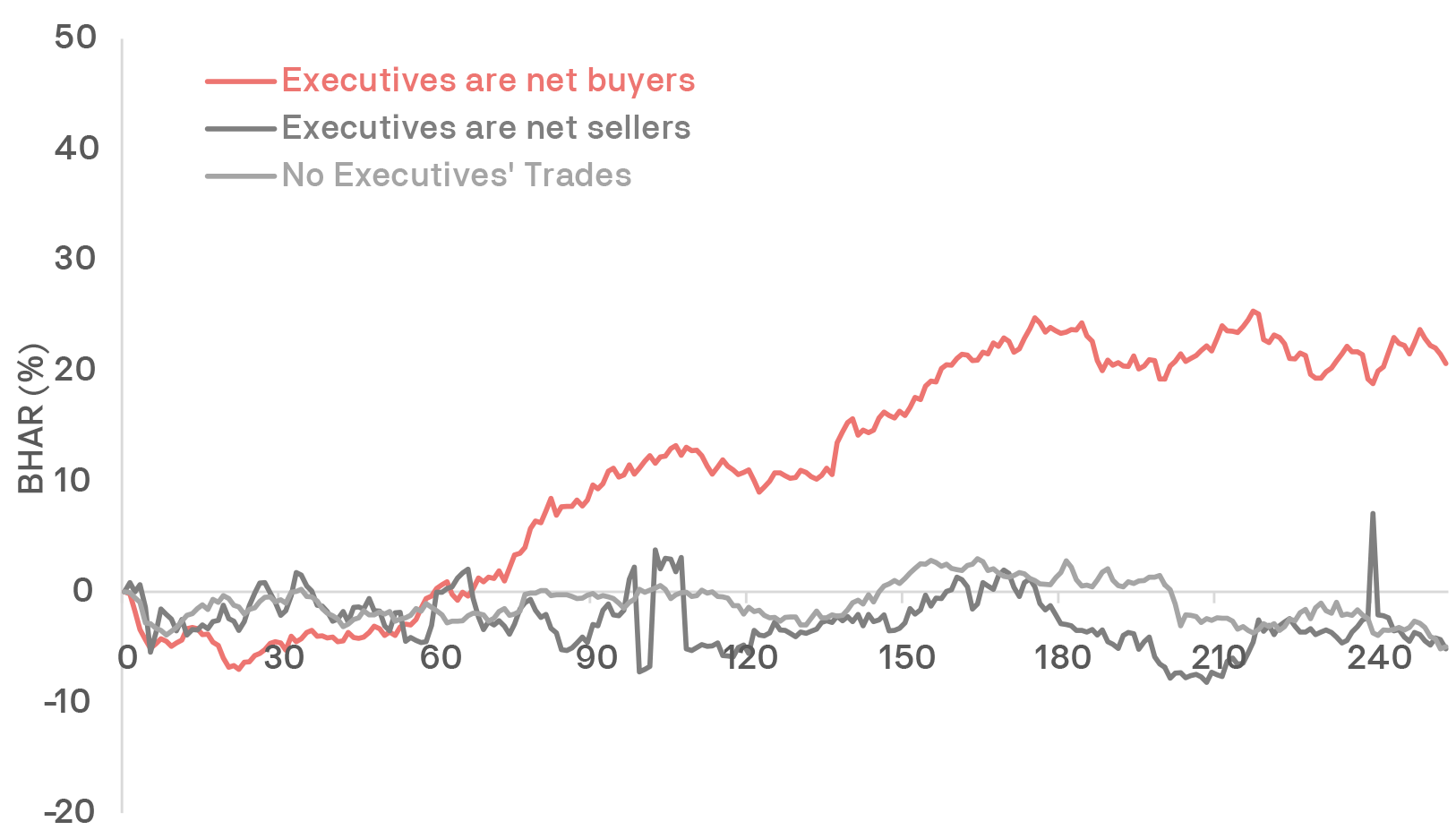
The excess return of spun-off companies in which management acquires shares is especially promising when management uses a negative tone in its communication with investors. As mentioned earlier, in spin-offs management has an interest in portraying the prospects of the spun-off company as worse than they actually are (incentivisation, management track record). If at the same time they buy shares in their own company, then the prospects of success are even more promising (see the chart below).
Component could not be found for blok RichTextCaseStudy! Is it configured correctly?
Conclusion: clear success factors in the assessment of spin-offs
In this Keynote Insights series on spin-offs, it has been pointed out that the return dispersion in spin-offs is very large: while successful spin-offs achieve very attractive excess returns, the worst spin-offs lead to very disappointing results. It is therefore of great importance for the investor to be able to distinguish the «good» spin-offs from the «bad» ones. Alongside an understanding of the reasons for a separation, five indicators were presented that have been scientifically examined and point to a positive price development in spin-offs:
- Reduction of the conglomerate discount: Through their increased focus, the spun-off companies (but also the parent groups) achieve a higher valuation, since investors prefer clearly focused companies. Particularly interesting, therefore, are focused spin-offs from broadly diversified conglomerates. But the parent company too can achieve a higher valuation through the separation, if a more focused company results from it.
- Management incentivisation: The remuneration of management in spin-offs is frequently tied to the price development and the operating performance of the «new» company. The interests of management are therefore aligned with those of the shareholders, which is positive for the spin-off's price development. Studies confirm this relationship.
- The «internal» CEO: If the CEO of the spun-off company was previously the division head of the same segment within the parent group, then the chances are good that he can quickly tackle positive changes, since he already knows the business well and can assess where changes will lead to quick results. This positive factor has been confirmed by scientific studies.
- Low analyst coverage: In spin-offs the availability of financial metrics is often limited, and the lack of initial interest from analysts means that information is only sparsely available. It is precisely this fact that enables investors to identify attractive investment opportunities in spin-offs.
- Insider buying: While institutional and passive investors (index products such as ETFs) must sell the shares of the spin-off, insiders often appear as buyers. Several studies have shown that spin-offs which experience buying by their own management after the separation perform very positively. Situations appear particularly attractive in which management, on the one hand, acquires shares while, at the same time, using a negative undertone in its communication with investors regarding the prospects of its own company.
In the first part of the Keynote Insight series on the subject of spin-offs, it was established why spin-offs are an attractive niche for equity investments. In this second part, some success factors were presented and illustrated with concrete case studies. When a company meets the right criteria, a spin-off is an excellent way to create added value for shareholders and to improve the long-term prospects and competitiveness of the parent company and the spin-off.
Note: The shares presented in this report may be part of the Keynote Spin-Off strategy. The investment cases reflect the opinion and view of Keynote at the time of publication, may change at any time and do not constitute a buy or sell recommendation.