Letter to Shareholders 2024
At regular intervals, we publish shareholder letters in which we report on our investment strategy, performance, portfolio changes and other important topics that our shareholders should be aware of.
Published onReading time 18 minutes
Dear Shareholders
With this second letter, we would like to inform our shareholders about developments since the launch of the Keynote – Spin-Off Fund on 21 July 2023.
The table below shows the performance figures for the past calendar year as well as the cumulative and annualised performance since the launch on 21 July 2023. The main share class of the Keynote - Spin-Off Fund* achieved a performance of 24.73% in 2024.
This compares with a performance of the MSCI World Net Return Index of 26.60% and the MSCI World SMID Cap Net Return Index of 16.88%. Funds in the Morningstar Global Flex Cap Equity peer group achieved an average performance of 13.58% in 2024 (all figures in EUR). Since launch, the Keynote - Spin-Off Fund has outperformed both the broad equity indices and the peer group.
| Wertentwicklung in EUR | 2024 | Seit Lancierung kumuliert | Seit Lancierung annualisiert |
|---|---|---|---|
| Keynote - Spin-Off Fund | 24.73% | 36.42% | 23.92% |
| MSCI World Net Return Index | 26.60% | 34.12% | 22.47% |
| MSCI World SMID Cap Net Return Index | 16.88% | 22.18% | 14.83% |
| Morningstar Global Flex-Cap Equity | 13.58% | 17.74% | 11.94% |
*Keynote Spin-Off Fund IK-USD Daten per 30.12.2024 Quelle: Bloomberg, Morningstar
Owing to its focus on spin-off situations, the fund is not aligned with any benchmark. The focus is on high risk-adjusted returns, medium-term capital preservation and long-term capital growth. Nevertheless, performance comparisons with the global indices and the peer group over a longer investment horizon are meaningful, since the fund's objective is to achieve higher risk-adjusted returns than the broad equity markets over an entire equity market cycle, and to do so with a comparatively low correlation.
The Overall Investment Climate
Price movements in the 2024 investment year were driven primarily by robust consumer spending and enthusiasm for groundbreaking advances in artificial intelligence (AI) and GLP-1 medications. The indices were strongly fuelled by the momentum of large-cap stocks, in particular the so-called Magnificent 7 (a Wall Street term inspired by the legendary Western «The Magnificent Seven»), which benefited from the AI trend. In anticipation of reduced regulation and increased M&A activity, financial stocks joined the rally following Trump's victory. Five stocks (Nvidia, Apple, Meta, Microsoft and Amazon) accounted for 45% of the rise in the S&P 500 Index, and the top 10 stocks for 60%. Market concentration has increased significantly in recent years: at the end of 2024, the Mag 7 accounted for more than a third of the S&P 500 Index and around a quarter of the MSCI World Index. Together, the technology, communications and financial sectors carry a weighting of around 55% in the S&P 500 Index and more than 50% in the MSCI World Index.
A comparable concentration of the largest stocks last occurred in the 1960s, before the Nifty Fifty stocks (the 50 dominant growth stocks of the day) peaked in 1973 and subsequently underwent a painful decline. A research paper (Stock Market Concentration: How Much Is Too Much?) by the multiple-award-winning analyst Michael Mauboussin covering the past 75 years finds that the S&P 500 Index historically achieved above-average returns when the concentration of the top 10 stocks was increasing, and below-average returns when a peak was reached and concentration declined. The effects of changes in concentration were particularly pronounced during the inflation and deflation of the dot-com bubble, with average annual index returns of 23.5% from 1994 to 1999 and only 3.6% from 2000 to 2013. Market concentration is a good thing for index investors, right up until the point when it isn't.
Where do we stand today? At present, it is not only concentration that is high. According to research house Empirical Research Partners, such a powerful outperformance of momentum stocks with the highest relative 12-month returns has rarely been seen over the past 70 years. The rally ranks among the top 3% of comparable price movements. This makes the relative outperformance of these stocks comparable to the TMT bubble (Technology, Media, Telecom) of the late 1990s (see chart below).
Source: Empirical Research Partners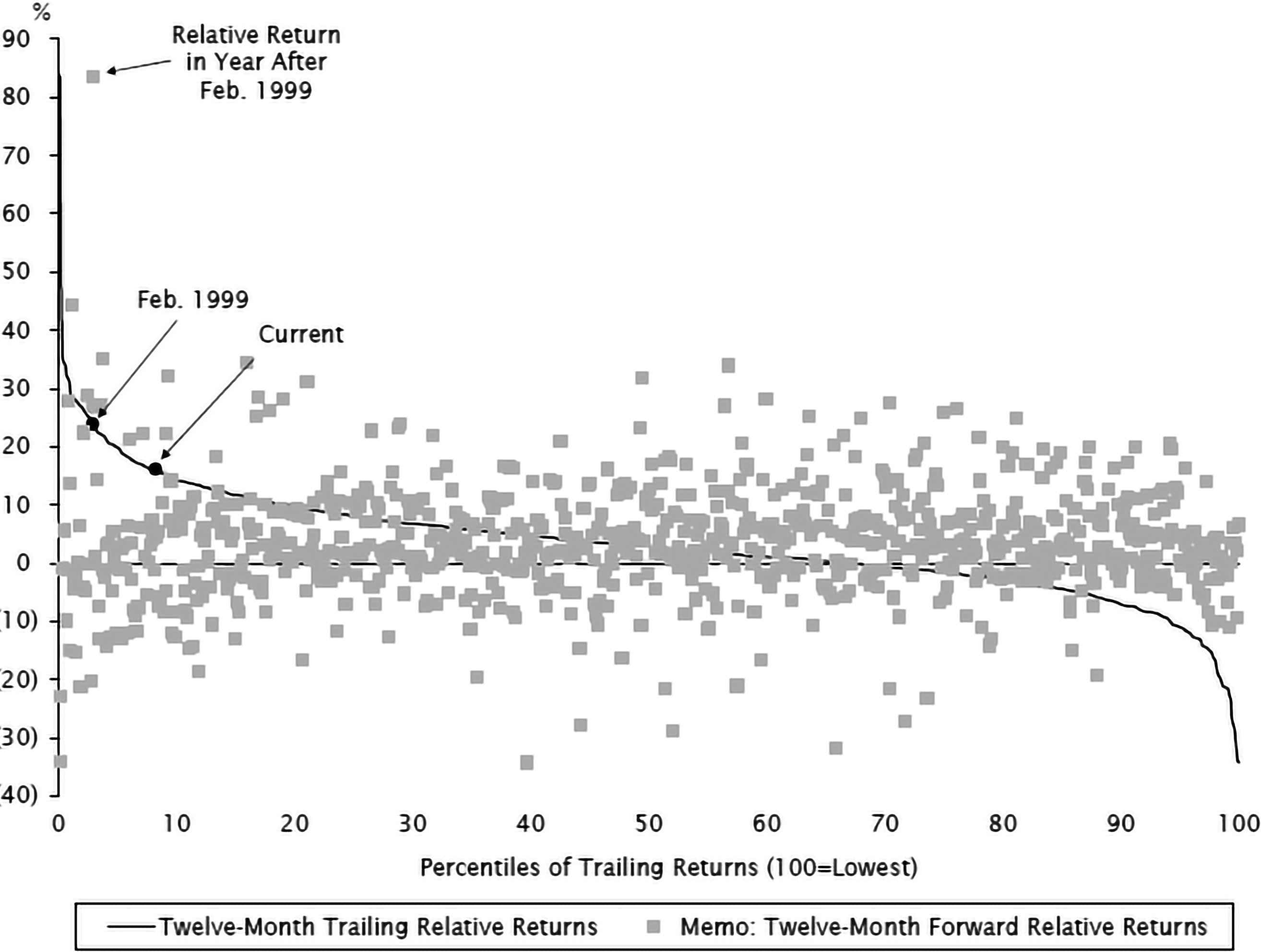
Despite – or perhaps precisely because of – Donald Trump's «unconventional» politics, the financial markets have taken an optimistic view of the 2025 stock market year following his election victory. Yet key measures of the Trump administration, such as tariffs and mass deportations, along with the planned drastic cuts to government administration by the DODGE organisation (Department of Government Efficiency), represent unpredictable, potentially disruptive elements. An equity mania like that of 1999 cannot therefore be ruled out. Historically, however, following an outperformance like that of 2024, the momentum factor delivered excess returns in the subsequent year in only 30% of cases.
When breaking down the components of the indices, one finds that the market is expensive across the board. The Mag 7 stocks are valued at 1.8 times the forward P/E of the market (S&P 500 = 22x). There is no doubt that their market position and generation of high free cash flows (FCF) justify a valuation premium and currently raise the opportunity cost of abandoning ship. More concerning is that highly cyclical momentum stocks such as banks are valued at 17 times earnings, compared with the historical average of 12.5 times – and this at net interest margins that have already reached record levels. Put differently: roughly half to two thirds of the index components display valuation levels that lie well above the historical average.
Valuations don't matter until they do. High expectations combined with high valuations are rarely a good combination for high returns. Over a three- to five-year horizon, the equity returns achievable in the broad equity markets are therefore most likely to fall below the historical average.
In connection with the increased tech weighting in the indices, it is important to understand that the risk profiles of Big Tech's business models have changed. One reason the large-cap IT groups performed so well over the past decade was that their business models were capital-light. Thanks to their monopoly power, the technology companies were able to retain most of their profits and use them for share buybacks and dividend payments. Yet competition and AI spending are increasing. Amazon, Microsoft, Google and Meta will invest over USD 329 billion this year, up from USD 227 billion last year. The capital intensity (measured by capital expenditure relative to net profit) of the largest technology companies will range this year from 65% (Microsoft) to 125% (Amazon), which is considerably higher than the median of S&P 500 companies (30%).
With the construction of physical data centres and the creation of industrial capacity using land, electricity and steel, the tech firms are no longer «capital-light». The massive capital expenditure (CAPEX) could erode Big Tech's hitherto high free cash flows. The «DeepSeek moment» at the end of January surprised the markets by demonstrating that Chinese firms can keep pace with OpenAI and Google despite limited hardware resources. Against the backdrop of the ordinary process of creative destruction (increasing competition, falling costs), Big Tech's billion-dollar investments are gradually appearing in a different light.
CAPEX is not bad per se, but the empirical evidence shows that extreme investment does not pay off from a shareholder's perspective. Capital-intensive business models historically achieve a lower return on capital, especially when irreversible costs meet intensified competition. The black bars in the following chart from Empirical Research Partners show the relative returns of the companies in the highest CAPEX-growth quintile. Over the past seven decades, firms with the highest CAPEX growth have consistently underperformed.
Source: Empirical Research Partners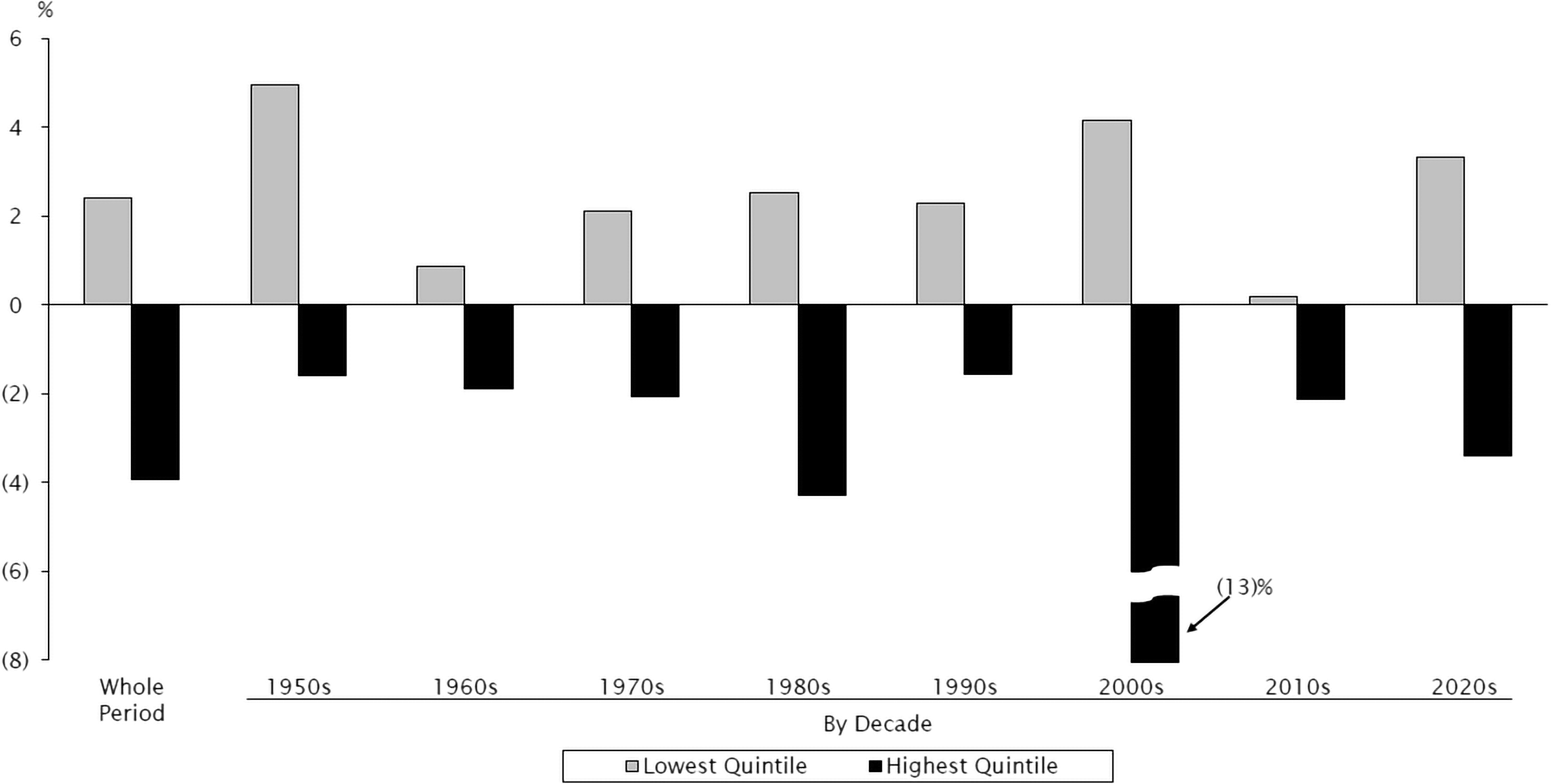
Extreme CAPEX growth leads to below-average equity returns. It is becoming increasingly clear that, following the development of AI infrastructure, LLMs (Large Language Models) will become commoditised and democratised in order to enable the next stage of product development towards real-world applications. Nvidia is not AI; it merely provides important hardware to meet the immense computing requirements of LLMs. Investors would therefore be well advised not to view the Mag 7 as a homogeneous group, as the companies' business models differ significantly. Incidentally, in the 1960s Western classic, only three of the Magnificent Seven survived. On the stock market, too, the wheat is likely to be separated from the chaff once the shooting starts and competition between the tech giants intensifies.
After several years of FOMO (Fear of Missing Out), investors are now relying, out of FOBO (Fear of a Better Option), on what has worked in the recent past. Yet playing the game that everyone else is playing – one that may work next week, next month or next quarter – is, over the medium and longer term, a strategy that can scarcely add value relative to the indices. We therefore focus on a differentiated investment strategy away from the mainstream.
Spin-Offs - Investing beyond Mainstream
The structure of the major equity indices can currently be described as «over-owned», «over-researched» and «over-valued». Charlie Munger, the late business partner of Warren Buffett, compared investing to fishing and pointed to two important principles of angling: the first is to fish where the fish are, and the second is never to forget the first.
Investing is similar: instead of fishing in the overfished oceans of the major equity indices, one should look for places where there is little competition. For a lack of competition is often a reason for mispricing. Investments in hard-to-access areas away from the mainstream present barriers that keep most investors away. This keeps prices low and returns high.
With the sharply increased inflows into passive index investments, the markets are becoming even more momentum-driven. This ultimately makes the market somewhat less efficient and opens up opportunities. Index funds and index-oriented investors frequently have to sell spin-offs for irrational reasons, namely because of the smaller market capitalisation of the spin-off, as the shares of the separated company are usually not included in the same indices as the overall group prior to the separation. Accordingly, index-oriented investors and ETFs must in any case dispose of the newly received shares – regardless of price. In spin-off situations, «value» is therefore regularly to be found – and often in companies with a leading position in niche markets and high-quality business models.
One of the most important principles of our active management approach is to identify and exploit persistent market inefficiencies. Spin-offs are a market segment in which the price of an asset frequently does not correctly reflect its value.
A separation enables any company to focus on its priorities – that is, its respective strategic and operational plans and projects. At the same time, it can pursue the capital structure best suited to the particular business, strategy and growth or cash flow profile. Through this «release into freedom», the separated companies can allocate their capital more effectively, better steer research and development, and increase efficiency. The resulting margin improvements and potential earnings growth at companies that reinvest their cash flow into the (newly focused) business are, as a rule, scarcely noticed by Wall Street research analysts and the investor community.
First-class spin-offs regularly achieve faster growth and higher profit margins than was the case within their former parent companies. The following table shows the development of the operating margins of all US spin-offs with a market capitalisation of more than USD 5 billion at the time of separation, from 2013 to 2023 (energy stocks and financial stocks were excluded owing to their volatile earnings development). The margins of the individual spin-offs were examined relative to the adjusted pro-forma margins stated in each company's documentation prior to the separation, which take into account all expected costs and transitional arrangements.
The analysis comprises a total of 31 spin-offs. On average, a margin improvement of +125 basis points was achieved in the first full financial year as a standalone company, compared with the adjusted standalone pro-forma margin published prior to the separation. Companies in the 75th percentile even recorded a margin expansion of +242 basis points, while companies in the 25th percentile saw a margin deterioration of around 66 basis points. Over a three-year horizon following the spin-off, an average margin improvement of +158 basis points was achieved, while companies in the 75th percentile attained a margin expansion of +301 basis points.
| Operative Marge | Durchschnitt | 25. Perzentil | 75. Perzentil |
|---|---|---|---|
| Erstes volles Jahr nach dem Spin-Off | +125 BPS | -66 BPS | +242 BPS |
| Drittes volles Jahr nach dem Spin-Off | +158 BPS | -76 BPS | +301 BPS |
Quelle: Trian analysis, FactSet
While margins in the overall markets are in many cases at record levels, margin improvements at spin-offs are regularly «built into the system». Consequently, quality spin-offs should grow their earnings and cash flows faster than the market and exhibit lower cyclicality and less downside risk than their peer group.
The low initial valuation is a temporary phenomenon, i.e. together with the margin improvements, the spin-offs should experience a re-rating over a three-year horizon. The combination of the initial valuation discount, the margin improvements and the associated re-rating ultimately delivers above-average performance.
The re-rating is not limited to the separated entity. The original parent companies also experience a re-rating. According to an analysis by Trivariate Research from 1999 to 2024, the forward earnings multiple of the parent companies expanded by a median of just over 200 basis points two years after the announcement of a spin-off (see chart below).
Source: Trivariate Research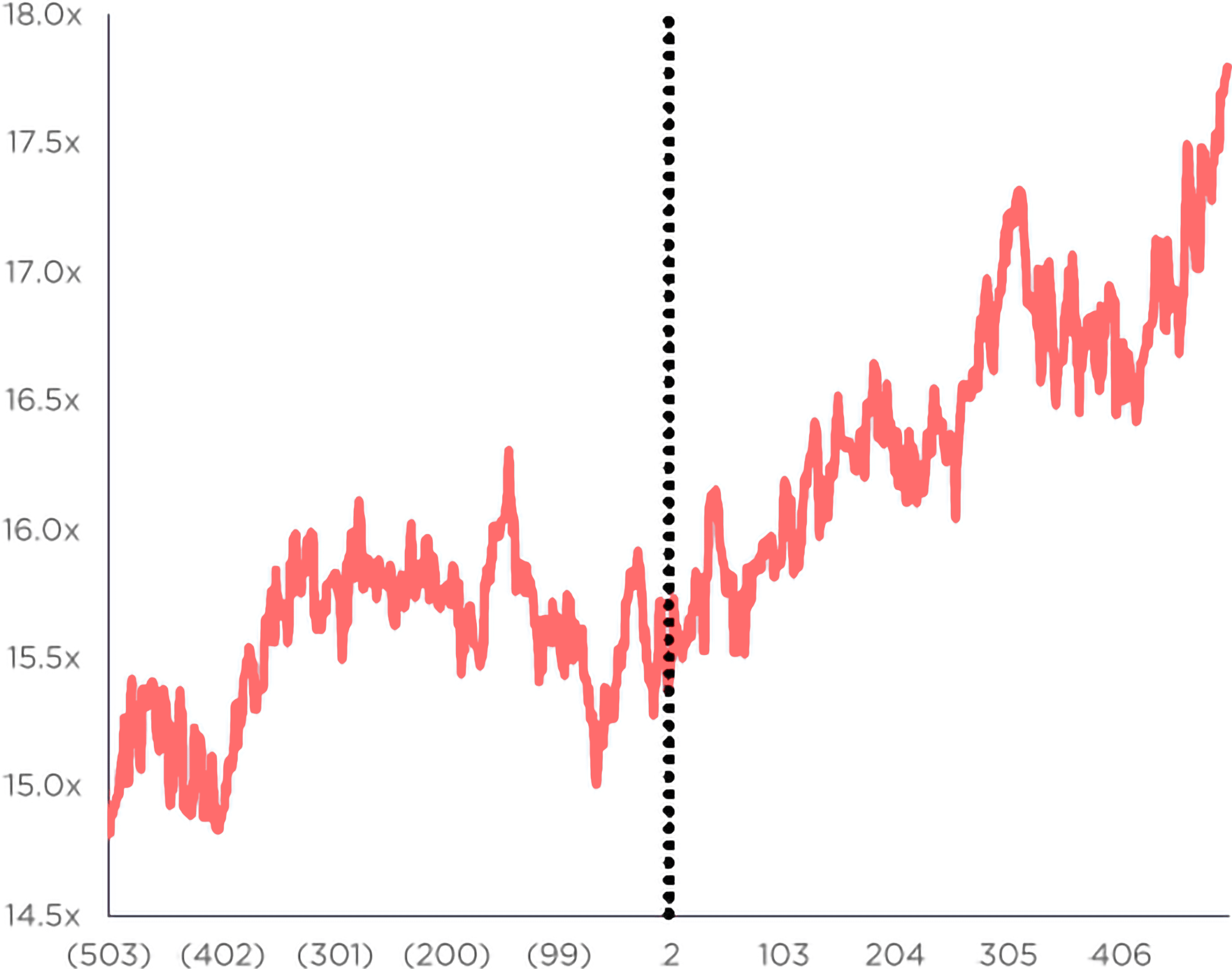
Conclusion: Despite the overwhelming academic evidence, spin-offs are neglected by investors, even though the spin-off mechanics (initial selling pressure, margin improvement and re-rating) have attractive returns «built in». Spin-off situations therefore offer a unique combination of «value», «quality» and «growth», as well as the potential for high risk-adjusted returns with a comparatively low correlation to the broad equity markets. We are willing to go against the consensus in spin-off situations, to question prevailing assumptions and to pursue our research process consistently. Spin-offs repeatedly offer opportunities to swim against the current and to achieve attractive risk-adjusted returns in an area that is systematically underestimated and misunderstood by the market.
Performance Review
To analyse the fund's performance over the past year in more detail, we consider below the three stocks that had the strongest positive and negative impact on performance. As always, let us begin with the problem cases:
BOTTOM 3
| Titel | Kategorie | Performancebeitrag |
|---|---|---|
| Valaris | Spin-Off | -2.26% |
| Mobileye | Spin-Off | -2.25% |
| SiriusXM | Spin-Off | -2.13% |
Daten vom 29.12.2023 bis 30.12.2024 Quelle: Bloomberg, Keynote
The shares of Valaris were under selling pressure because offshore day rates had stalled and there was a pause in the awarding of new contracts. This pause was, however, less related to falling oil prices than to the shortage of FPSO vessels (floating production, storage and offloading units). As old contracts for cheap rigs expire, the rigs will in future be re-awarded at much higher prices. Following the spin-off of the predecessor company and several capital market transactions, the new Valaris possesses the best combination of a newer, high-quality fleet of rigs, low debt and automatically rising earnings. At the range of today's day rates, the company should be able to generate free cash flow of between USD 560 million and USD 1.65 billion per year in 2026/27. This puts the FCF yield at between 18% and 55%.
When we identify mispricings, we establish initial positions and gradually build them up if the shares fall to a lower level. In the short term this can entail book losses, but over the long term it has paid off – provided the investment case remains intact. Valaris has a high, asymmetric return profile that is even greater today than at the time we bought the initial positions.
With Mobileye, by contrast, our investment thesis did not prove correct. In such cases there is only one conclusion for us: we sell as quickly as possible, even if this means realising losses. Mobileye, which was spun off from Intel, produces chips, cameras and software for automated driving. We regarded the stock as attractive, as autonomous-driving solutions are only at the beginning of the adoption curve. Following the separation, strong growth was to be expected from Mobileye as a «pure play». A combination of factors – such as the high inventories of Mobileye's EyeQ system-on-chips held by carmakers, slowing growth in the automotive market, the high China exposure and increasing competition – ultimately prompted us to sell the stock.
At SiriusXM, we liked the stable business model and the low valuation (FCF yield of over 11%). Yet following the split-off and merger between Liberty Media and Sirius XM, the shares remained under selling pressure owing to declining subscriber numbers and a disappointing outlook for 2025. Since the weakness in the largest distribution channel (new and used cars) is likely to persist for now, we parted with the stock to make room for new names. However, we continue to monitor the company with a view to a possible reassessment during the course of 2025.
What went particularly well in 2024? Fortunately much did, but the following stocks in particular:
TOP 3
| Aktie | Kategorie | Performancebeitrag |
|---|---|---|
| SharkNinja | Spin-Off | +3.72% |
| Knife River | Spin-Off | +3.28% |
| GE Aerospace | Spin-Off | +3.20% |
Daten vom 29.12.2023 bis 30.12.2024 Quelle: Bloomberg, Keynote
SharkNinja, a year and a half after its spin-off, is recording sustained high growth and continues to gain market share with its Shark (vacuum cleaners, hair dryers) and Ninja (blenders, ice cream makers, outdoor grills and smokers) brands, as innovative products are offered at affordable prices. At SharkNinja, innovation does not mean merely launching new products. It is also about reshaping existing segments and creating new consumer expectations. In the Shark and Ninja subcategories alone, six and ten new products respectively were introduced in the past three years. Since 2008, the company has increased revenues by 20% p.a. Growth rates in the mid-teens are likely to remain realistic in the coming years too. As it grows in size, the budget for research and development increases, and with it the gap between SharkNinja and its competitors.
At Knife River, analysts and investors are increasingly coming to the realisation that the business is less cyclical than thought. Demand growth in public projects offsets the weakness in private projects, particularly in residential construction. Thanks to stable demand for aggregates and limited capacity, aggregates producers have pricing power. Management is focused on expanding the aggregates business in order to build on its competitive advantage of low-cost production. Aggregates have a low value-to-weight ratio, which gives cost advantages to those producers operating closer to end-customer demand. The result of the disciplined capital allocation is returns on capital employed that exceed those of competitors.
GE Aerospace showed a growing order backlog, rising revenues, profits and free cash flows in 2024. GE Aerospace operates effectively as a duopoly with Rolls-Royce in the wide-body engine market and with Pratt & Whitney in the narrow-body engine market. Since engines are typically in service for more than 20 years and GE Aerospace generates 70% of its revenue in the civil segment and in engine services through the maintenance of its engines, it achieves a stable, low-cyclicality income stream. Following the break-up of the old GE into three parts, the market is increasingly recognising the high barriers to entry and the quality of GE Aerospace's business model.
Positioning and Portfolio Activity
The Keynote – Spin-Off Fund invests broadly across all sectors. Based on our bottom-up selection, spin-off situations from the industrial sector represented the largest weighting at the sector level in the past 2024 investment year.
In April 2024, General Electric was split into GE Aerospace (see above) and GE Vernova (wind and gas turbines and other energy infrastructure). We used the initial selling pressure in GE Vernova to add to our position, but parted with the stock over the course of the year. Driven by the narrative that electricity demand for AI applications and data centres would increase massively, the stock was caught up in a strong valuation expansion.
Alongside GE Aerospace, Crane Co. and ESAB are core positions of the fund. Crane Co., with its two business segments «Aerospace & Electronics» and «Process Flow Technologies», has a stable business (40% aftermarket share) with high FCF conversion (90-100%) that should generate double-digit percentage earnings growth rates for the foreseeable future. ESAB, a manufacturer of welding and cutting equipment as well as welding consumables, will further drive margin expansion through the simplification of its product line, the consolidation of production and the shift towards higher-margin equipment sales. ESAB is developing into a «high-quality compounder» and is likely to record annual earnings growth in the mid-teens with high FCF conversion (>100%) over the coming years.
Attractive opportunities have increased our sector positioning within the energy sector relative to 2023. Through their focus, the fund's spin-off situations create the potential for better capital allocation. Together with a potentially more favourable environment in the oil and gas markets, this will create the conditions for higher free cash flows, which our holdings can use for share buybacks and dividend payments. In addition to Valaris (see above), the core positions include TechnipFMC. During the multi-year downturn of the past decade, TechnipFMC, as a technology and innovation leader in the subsea market, focused on developing differentiated integrated system solutions for its customers, covering the entire life cycle from conception through project execution to maintenance. Following the spin-off of Technip Energies, TechnipFMC stands out clearly from its competitors as a «pure play» with its subsea solutions (prefabricated modular architectures) and has the potential to industrialise the subsea market.
Aufteilung nach Sektoren
| Industrie | 37.2% |
| Energie | 16.7% |
| Gesundheitswesen | 12.0% |
| Grundstoffe | 11.0% |
| Informationstechnologie | 11.0% |
| Basiskonsumgüter | 6.3% |
| Nicht-Basiskonsumgüter | 4.8% |
| Kasse | 1.0% |
Daten per 30.12.2024 Quelle: Bloomberg, Keynote
The health care segment recorded a poorer performance than the broad equity markets over the past two years. Healthcare companies have struggled with rising costs and falling revenues since the pandemic. Nevertheless, spin-off situations in the healthcare sector play an important role in the portfolio, as these offer stable growth potential at attractive valuations. The core position Sandoz performed very pleasingly, contrary to the sector as a whole. This performance was underpinned by solid operating development. GE HealthCare and ZimmVie were disposed of in the reporting year after their price targets were reached. A wave of innovation is changing the sector's prospects, and against this backdrop new positions in promising spin-off situations were built up in these areas.
In the materials sector, the fund focuses with Knife River and Holcim on asymmetric spin-off situations that are less cyclical than the market assumes. This attractive risk profile was no longer present at the utility CEG Energy following its strong share price performance and the associated valuation expansion, which is why we disposed of the position.
In the consumer discretionary and consumer staples sectors, the fund acts very selectively and, alongside SharkNinja (see above), invests in Bellring Brands. Many consumer goods companies face new challenges in addition to price pressure, including the changing preferences of consumers towards healthier, more natural foods and beverages. Bellring Brands is the largest provider of ready-to-drink protein shakes and has secular tailwinds from the growing health and wellness trend. Unlike other companies, the firm is not negatively affected by the newly launched GLP-1 weight-loss medications, but is instead likely to be a second-round beneficiary. The residual position in Ferrari was sold at the end of the year, as the stock had reached luxurious valuation levels.
In the technology and communications sector, too, the fund proceeds very selectively and focuses primarily on company-specific changes. Having already had a first date with the online dating platform Match Group in 2023, we used the price decline in the spring to build up a position once again. In anticipation of a stabilisation of Tinder and the strong growth of the relationship-oriented app Hinge, we wanted to enter into a longer-term relationship. But the spring feelings did not amount to more than that, which is why we parted with the stock again a few months later. Although the business model offers potential, management does not appear to be capable of engineering the turnaround.
In the technology sector, we look for attractively valued, idiosyncratic investments that we expect to perform well in most economic scenarios. The core positions include Constellation Software. Here we like the indispensability of its products in niche markets, combined with the high margins and attractive capital allocation.
As at the end of 2024, spin-offs made up the largest part of the portfolio at 63.7%, followed by parents (23.3%) and pre-spin situations (13.0%).
Aufteilung nach Aktiensegmenten
- 13.0%Pre-Spins
- 23.3%Parents
- 63.7%Spin-Offs
Daten per 30.12.2024 Quelle: Keynote
Compared with the previous year, parents and pre-spins account for a higher share because Mr Market offered an above-average number of attractive «bottom-up» opportunities in these two categories. The quality companies in these two categories are characterised by the fact that, over the coming three years, they will display organic revenue growth in the high single-digit or low double-digit range and will grow earnings per share by over 15% p.a. At the same time, their valuation relative to the overall market trades at an unjustified discount. All of these firms have good management teams, improving capital allocation and should be in a stronger position over the coming 12 to 24 months, because separations of business divisions are imminent or have already taken place.
As at the end of 2024, the portfolio comprised 21 holdings. The five equity holdings that carried the highest weighting at year-end are listed below:
TOP 5 Holdings
| Aktie | Kategorie | Gewicht |
|---|---|---|
| GE Aerospace | Spin-Off | 7.25% |
| Constellation Software | Parent | 6.58% |
| Knife River | Spin-Off | 6.33% |
| Bellring Brands | Spin-Off | 6.31% |
| ESAB | Spin-Off | 5.70% |
Daten per 30.12.2024 Quelle: Bloomberg, Keynote
Summary and Outlook
Valuations have risen across the board – not just among the mega-cap market leaders. In anticipation of regulatory relief as well as monetary and fiscal stimulus measures, the markets are reflecting sustained economic and earnings growth. This scenario may materialise and continue to buoy the markets in the short term. Over a multi-year horizon, however, the upside potential of the broad equity markets is likely to lie below the historical average, which is why «stock picking» will take on decisive importance.
This expected market scenario represents an extremely interesting environment for an equity strategy focused on spin-off situations. The performance of spin-offs is driven less by the ups and downs of the markets than primarily by company-specific factors (rising margins, free cash flows and returns on capital employed). In a benchmark-oriented world driven by passive money, attractive investment opportunities away from the mainstream thus present themselves. With the aim of achieving high absolute, asymmetric returns, we continue to search «bottom-up» for the most attractive spin-off situations, and in 2025 too we will ignore the macro noise.
The Board of Directors and the Portfolio Management
KEYNOTE (SICAV)
KEYNOTE - SPIN-OFF FUND