Regime Change
Why the markets are facing structural changes.
Published onReading time 11 minutes

Keynote Insight Regime Change
At the start of the year, the popular annual forecasts of Wall Street strategists do the rounds. This kind of forecast is of little use. Investors should instead focus on the structural changes that will influence the investment markets over the longer term. With the outbreak of the COVID crisis, a regime change has set in: through the fiscal stimulus programmes and the state guarantees granted, governments are taking control of the banking system, which will bring structurally higher inflation rates and, over the medium term, will represent a burdening factor for the broad equity and bond markets.
The past year is a prime example of why the popular annual index-level forecasts among Wall Street strategists are utter nonsense. But imagine you had had a crystal ball and known at the beginning of 2020 that a global pandemic would break out, that as a result of shutdowns global gross domestic product would collapse by 9.8% in the second quarter, and that the restaurant, hotel and travel industries, as well as large parts of traditional retail, would be on the brink of the abyss. Would you then have concluded that global equity markets would gain more than 10% in 2020?
It is therefore no surprise that over the past twenty years the top Wall Street strategists have regularly been wide of the mark with their index forecasts (see chart below).
Source: Davis Advisors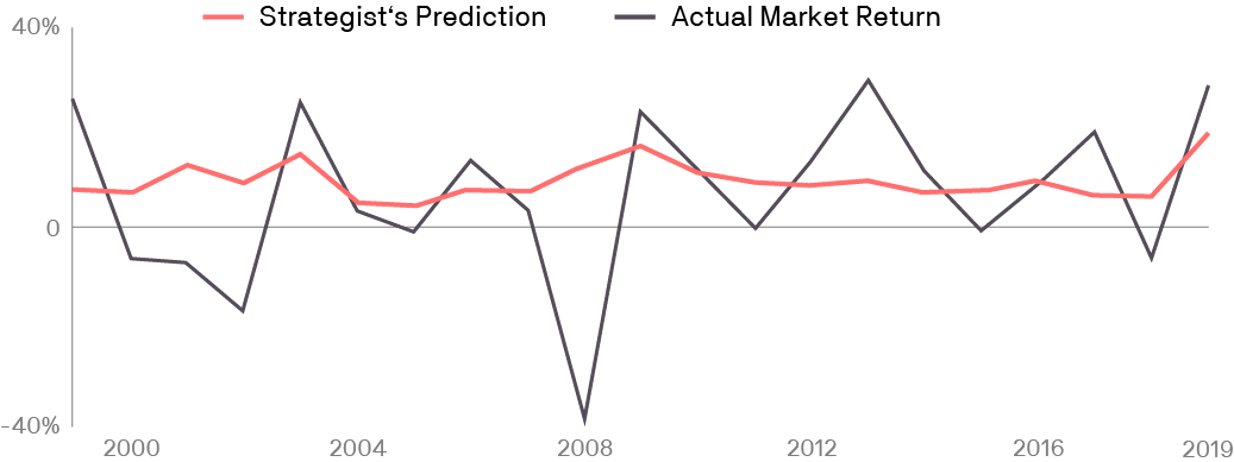
On this, the well-known investor Warren Buffett explains:
«We have long felt that the only value of stock forecasters is to make fortune tellers look good. Even now, Charlie \[Munger] and I continue to believe that short-term market forecasts are poison and should be kept locked up in a safe place, away from children and also from grown-ups who behave in the market like children.»
Warren Buffett
Berkshire Hathaway Shareholder Letter 1992
We agree with Warren Buffett entirely. As Mark Twain is said to have remarked, forecasting is difficult, particularly when it concerns the future. In our view there are only two kinds of forecasters: those who know that they cannot do it, and those who do not know that they cannot do it. We count ourselves in the first category.
The markets are facing structural changes
We focus on the structural changes that will influence the investment markets, and less on the index level at the end of the year. We have concluded that with the outbreak of the COVID-19 crisis, the shutdowns, and the subsequent deployment of state bank-credit guarantee schemes, just about everything we have seen over the past twenty years has changed.
The following chart vividly illustrates what we mean when we speak of structural changes. It shows the central bank balance sheet of the US Federal Reserve (red chart) and government net borrowing in the USA (blue chart).
Source: Macrobond, Clocktower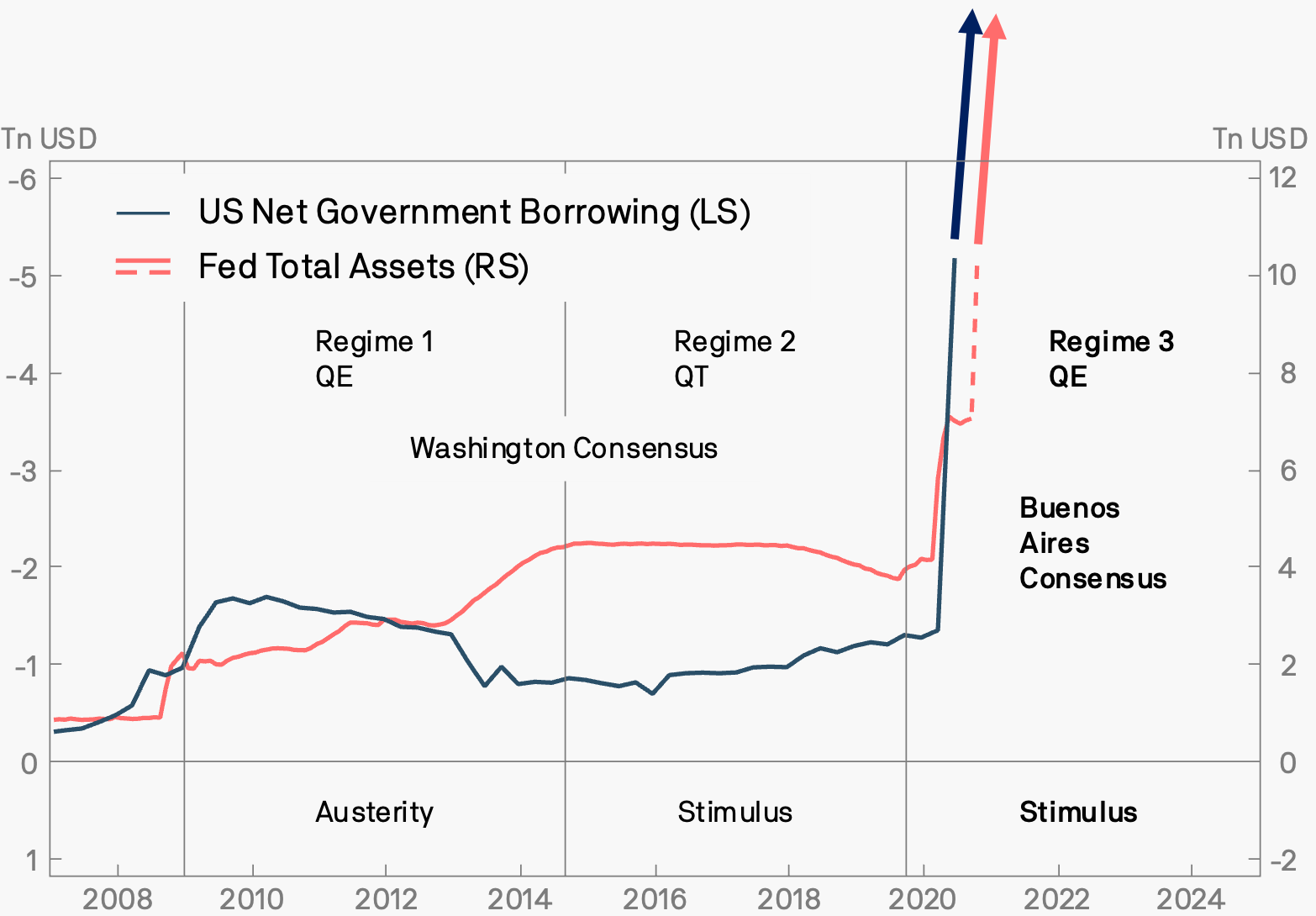
Over the past fifteen years, stimulus was applied to a greater extent either through monetary policy or via fiscal policy. But by the time the COVID-19 crisis broke out at the latest, a change of thinking set in among politicians and a moderate policy stance was abandoned («Buenos Aires Consensus» as the «New Normal»).
We are of the view that fiscal policy will become the linchpin in the coming years, that there will be an erosion of the independent central bank and more regulation. At the same time, a reorganisation of global supply chains is taking place: the trend towards de-globalisation that has begun is likely to continue. And this will have far-reaching consequences for the economy and the investment markets.
Disinflationary and deflationary tendencies since the 2008 financial crisis
A widespread misconception since the outbreak of the 2008 financial crisis was that the quantitative easing (QE) programmes launched by the central banks would create money and lead to inflation. In fact, over the past twelve years disinflationary or even deflationary tendencies have been observed. The central banks carried out these QE programmes in order to lower interest rates and to create reserves in the system against which the banks could lend.
Thus, while the central banks did expand their balance sheets, the commercial banks did not use these reserves as collateral to grant loans, because they considered the risks too high. As the famous economist John Maynard Keynes noted back in the 1930s, you can lead a horse to water, but you cannot make it drink.
Over the past twelve years, the central banks therefore failed to induce the commercial banks to lend and thereby create money. Rather, their measures kept interest rates low, which drove up asset prices and enabled companies to take on debt at favourable terms by issuing bonds. In the recent rounds of quantitative easing, the central banks bought securities from pension funds and retirement institutions. By law, these institutions must invest the money in other assets. Thus, the money remained within the financial markets.
In the real economy, by contrast, the situation deteriorated. The lack of growth in the broad money supply, low nominal economic growth and high debt growth led to a disinflationary or deflationary environment. After the last two crises, in 2000 and 2008, lending declined, as the illustration below shows. Especially after the 2008 financial crisis, the financial sector was on its knees. Lending no longer functioned.
Source: Alpine Macro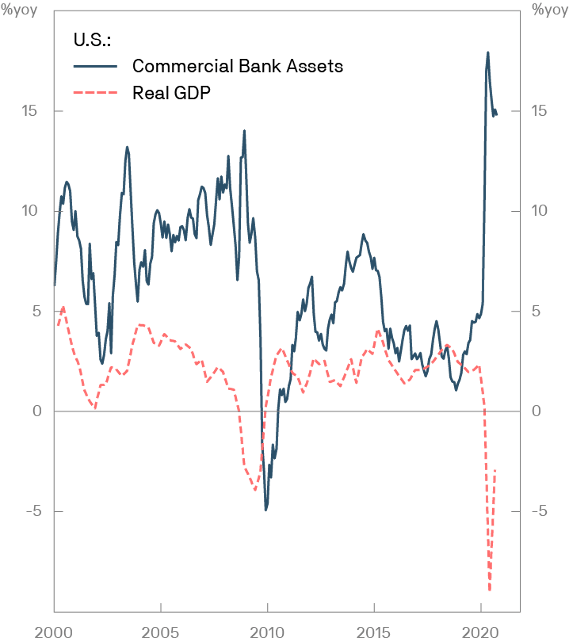
The new «Zeitgeist» and inflation after the COVID-19 crisis
Today, by contrast, the situation looks different. Although we are dealing with the worst recession since the Second World War, we are seeing the fastest increase in the broad money supply and lending volume in the last 30 years (see chart above).
So what has changed? Thanks to the bank-credit guarantee schemes, money is now created, in effect, by governments rather than by central banks. The governments provide the banks with sureties and state guarantees so that they extend loans to companies. In this way the central banks are bypassed entirely. The commercial banks thereby have an incentive to lend. For as soon as a government offers the bank this guarantee, the bank begins to lend money.
A credit guarantee is not a fiscal expenditure but merely a contingent liability – so government budgets are not initially burdened. Our politicians now hold in their hands a powerful instrument that they will no longer let go of.
In addition to such sureties and guarantees, massive investment and stimulus packages have been passed to support the economy. It is unlikely to stop there: after the coronavirus programmes there will be reconstruction programmes and infrastructure programmes, and in the near future investment programmes for the «green future» are likely to follow.
So far, governments have definitely done a good job of creating this money: growth in the total number of dollars in the world has risen by 25% compared with the previous year. For the yen it is around 9%, and for the euro more than 10% year on year. The money that the banks are now distributing thanks to the state guarantees goes directly to small and medium-sized enterprises and consumers, and less to large firms. For the moment they are not spending it, but with a reopening of the economy and the associated normalisation, the money will come into circulation.
The Covid-19 vaccines will unleash enormous pent-up demand around the world. An important point in this context remains the rise in household savings rates in the industrialised countries as a result of the closures, travel restrictions and increased transfer payments.
The personal savings rate in the USA rose from 7.2% of disposable income in December 2019 to a peak of 33.7% in April 2020, and in December still stood at 13.7%. In the eurozone, by contrast, the household savings rate rose from 12.5% of disposable income in the fourth quarter of 2019 to a record 24.6% in the second quarter of 2020, and in the third quarter of 2020 still stood at 17.4%.
US consumers alone have accumulated excess savings of more than 2 trillion dollars since February. This corresponds to around 10% of gross domestic product.
The chances are therefore good that a new economic cycle will begin in which growth, thanks to fiscal policy, will turn out surprisingly positive. At the same time, however, we will also see higher inflation rates.
Consequences for investment policy
But what does this regime change mean for the stock markets? Inflation and asset prices are inversely correlated: asset prices normally rise amid strong economic growth but low or falling inflation. The former means rising corporate profits, while the latter leads to low or falling interest rates. When inflation begins to rise, the whole process reverses above a certain inflation level.
Bonds are currently unlikely to be the right place for investment. The Credit Suisse yearbook examined the effects of various inflation regimes on asset prices, using annual data from 21 countries since 1900. Bonds perform best in times of low inflation (see chart below); with rising inflation rates, by contrast, their returns fall significantly.
Source: Credit Suisse Global Investment Return Yearbook 2021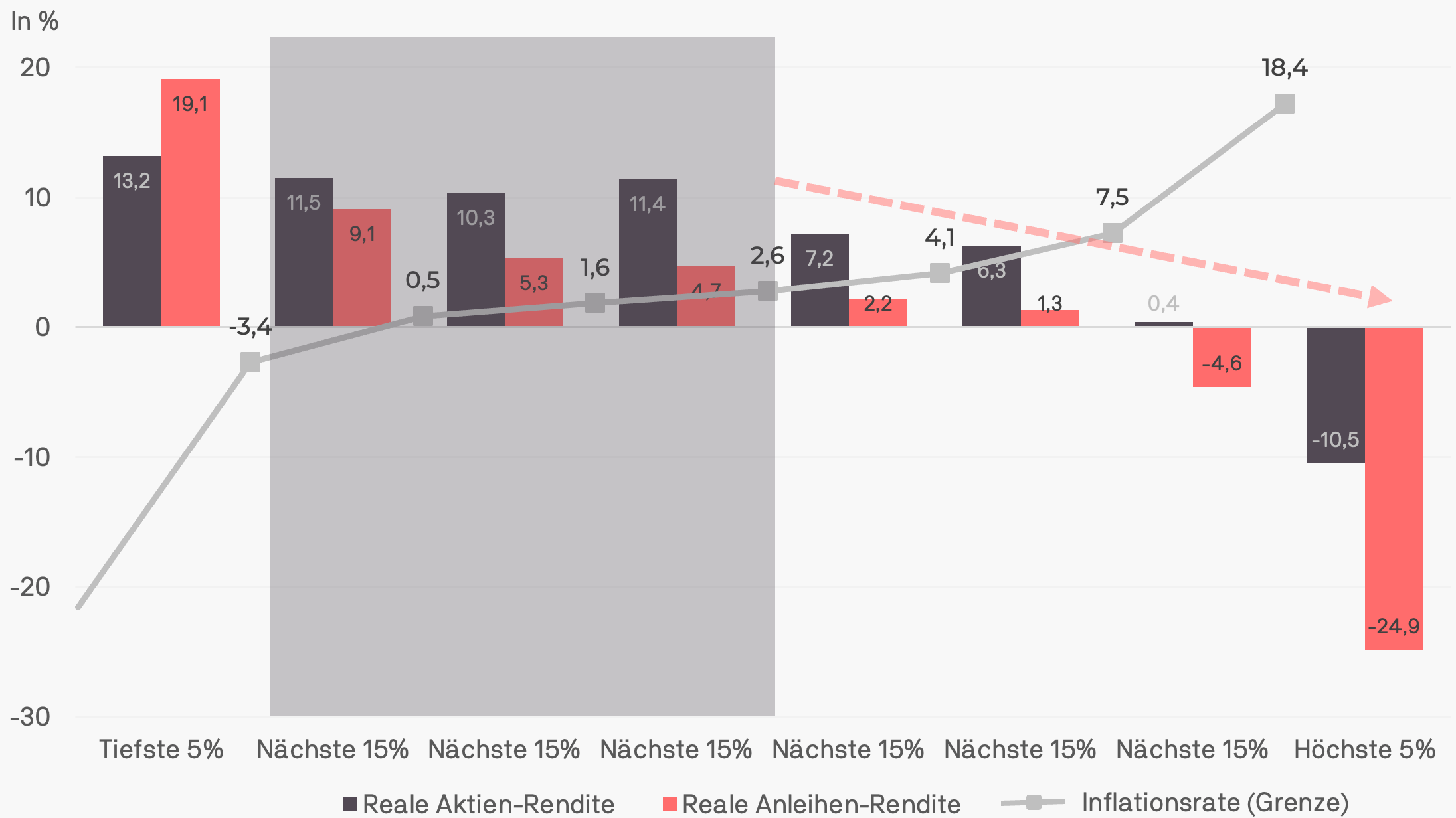
Equities, by contrast, have historically shown remarkably little sensitivity – until inflation exceeds levels of 2.6%. From that point on, they perform significantly worse. So should the change of policy indeed lead once again to sharply rising inflation, not only bonds but also the bulk of equities will run into trouble.
If one heeds Warren Buffett\`s lessons following the 1970s, which were characterised by high inflation rates, and applies them to 2021, not much translation is needed:
«High rates of inflation create a tax on capital that makes much corporate investment unwise – at least if measured by the criterion of a positive real investment return to owners. This «hurdle rate», the return on equity that a company must achieve in order to produce any real return for its owners, has risen dramatically in recent years. The average tax-paying investor is now running up a down escalator whose pace has accelerated to the point where his upward progress is nil.»
Warren Buffett
Berkshire Hathaway Shareholder Letter 1980
First-class quality companies with specific characteristics
The hasty conclusion from Buffett's insights might be to invest in firms that possess plenty of assets which rise in value when inflation increases. In fact, we try to avoid companies that are dependent on tangible assets such as buildings or production facilities.
For well-financed competitors can easily replicate such companies and compete with them. In many cases such competitors are able to become better than the original simply by installing the latest technology in their factory. Banks are, as a rule, very keen to lend against the collateral of tangible fixed assets, i.e. such companies tend to be more heavily leveraged.
In his most recent shareholder letter, Warren Buffett writes on this:
«Our leading position in the ownership of fixed assets is, incidentally, not per se a sign of investment success. The best results are achieved by companies that require only minimal assets to conduct a high-margin business – and that offer goods or services that will expand their sales volume with only a modest need for additional capital. We do indeed own a few of these exceptional businesses, but they are relatively small and grow slowly at best.»
Warren Buffett
Berkshire Hathaway Shareholder Letter 2020
We are of the opinion that by far the most important criterion for assessing the quality of a firm is the return that a company generates on the capital employed. When we invest in companies with «real assets», then they must, as in the case of our portfolio holding Bakkafrost, have solid balance-sheet structures and possess unique assets that are hard to replicate.
By first-class companies we mean firms that generate a sustainably high return on capital employed and can reinvest a large part of the cash flow back into their own business at this high return.
High returns on capital in combination with rapid growth can come in many forms, but as a rule they rest on intangible assets such as, for example, brands, patents, customer relationships, distribution networks, or an installed base of devices or software.
Why capital-light companies that generate high returns on capital provide better protection against inflation than capital-intensive companies is illustrated by the following example.
«Quality Ltd» achieves an annual return on capital employed (ROCE) of 45%.
«Average Ltd», which possesses plenty of tangible assets, by contrast generates a return on capital of only 10%.
Let us assume that inflation rises by 5% and that neither company can pass on the increased price levels (quality firms can, as a rule, push through higher prices). At both firms the return on capital falls by the level of inflation, but note the greater impact at «Average Ltd»: here the return on capital employed halves, while at «Quality Ltd» it declines by only 11%.
Illustrative Darstellung: Einfluss von 5% Inflation auf die Kapitalrendite der Qualitäts AG vs. Durchschnitts AG
| Unternehmen | ROCE 2020 | Inflation | ROCE 2021 | Veränderung in % |
|---|---|---|---|---|
| Qualitäts AG | 45% | 5% | 40% | -11% |
| Durchschnitts AG | 10% | 5% | 5% | -50% |
Quelle: Bloomberg, Keynote Funds
The two figures are, incidentally, not arbitrarily chosen but correspond to the figures of the Keynote portfolio (Quality Ltd) and the MSCI World Index (Average Ltd) as at the end of 2020.
An important indicator of a company's pricing power is, moreover, the gross profit margin. Put simply, the gross margin is the portion of revenue that remains to a company after the direct costs of producing the goods and services sold. It signals whether the core of a company is profitable, and also indicates a firm's ability to withstand shocks.
The gross profit margin of «Average Ltd» stands at 32%. In other words, this means that the firms in the MSCI World equity index produce goods and services for 68 USD and sell them for 100 USD.
The firms in the Keynote portfolio, by contrast, produce goods and services for 44 USD and sell them for 100 USD. Here too, as a general rule, the higher the better. And that is above all the case with higher inflation. For rising input prices have a greater impact on the lower gross profit margins of «Average Ltd» than on those of «Quality Ltd».
Conclusion and outlook
We have no crystal ball that could reveal to us the index levels at the end of the year. While most investors continue to focus on Big Tech or the «hot», mostly virtual areas of the market (cloud stocks, stay-at-home, Bitcoin, etc.), the real party will in future probably take place in the real world and away from the mainstream. The Keynote portfolios are positioned accordingly.
We have gone into detail on the structural changes that we will see in the financial markets in the coming years. This will have consequences for investment policy. Historically, structurally higher inflation rates led to rising interest rates (that is, falling bond prices) and to a valuation contraction in equities, and thus to disappointing returns in the broad equity markets.
Notwithstanding the fact that we too have no crystal ball, this does not change much about our methodology. We mention this because, despite our expectation of a post-pandemic economic boom, we will not reposition the portfolio into highly cyclical equities, financial stocks and heavily leveraged companies, which could benefit most from a recovery (but which, in the event of a persistently difficult economic situation, could also go bankrupt).
Whatever our view on the economy, inflation and interest rates, the Keynote portfolios will always be invested in high-quality companies away from the mainstream that meet our demanding criteria for financial performance.