Why spun-off business units offer attractive investment opportunities
Numerous studies confirm beyond doubt that spin-offs offer attractive investment opportunities. Nevertheless, the majority of investors appear to give spin-offs a wide berth.
Published on·Reading time 14 minutes
Keynote Insights - Spin-Offs
In this first part of the Keynote Insights series on spin-offs, you will learn what exactly spin-offs are, why they are carried out and why the special spin-off 'mechanics' lead to attractive situations from an investor's perspective. The second part discusses what should be given particular attention when assessing spin-offs and which spin-offs currently appear promising.
Three well-known multinational corporations – General Electric, Johnson & Johnson and Kellogg Company – have announced that they will split their business into several independent companies over the course of 2023. All three companies were founded more than 115 years ago and developed into multinational corporations over the following decades. Now all three have decided, in quick succession, that splitting up is the best way to maximise shareholder value.
General Electric (GE), founded in 1892 by Thomas Edison and once the largest and most powerful company in the USA, is splitting into three independent companies: the healthcare and energy divisions are to be spun off into standalone listed companies, so that GE will operate the GE Aviation division as its last remaining asset. The spin-off of the healthcare division is expected to be completed by early January 2023; the energy division will follow a year later.
Johnson & Johnson (J&J), founded in 1886 by the brothers Robert Wood Johnson I, James Wood Johnson and Edward Mead Johnson, declared its intention to separate its consumer health division – which includes brands such as Band-Aid, Tylenol, Listerine, Nicorette and Neutrogena – into a separate company. Going forward, only the prescription pharmaceuticals and medical devices business divisions will continue to operate under the J&J banner. The split is expected to begin over the next 12 months.
Kellogg Company (K), one of the world's largest manufacturers of cereal products and best known for its cornflakes, also announced in June this year its plans to split into three companies. Founded in 1906, the company plans to spin off, firstly, its North American cereals business with famous names such as Kellogg's Corn Flakes, Special K and Froot Loops, and secondly, its business in vegetarian and vegan meat-substitute products. The core is to be formed in future by the international snacking business with brands such as Pringles, Cheez-It and Rice Krispies, which already accounts for the largest share of revenue.
What is a spin-off?
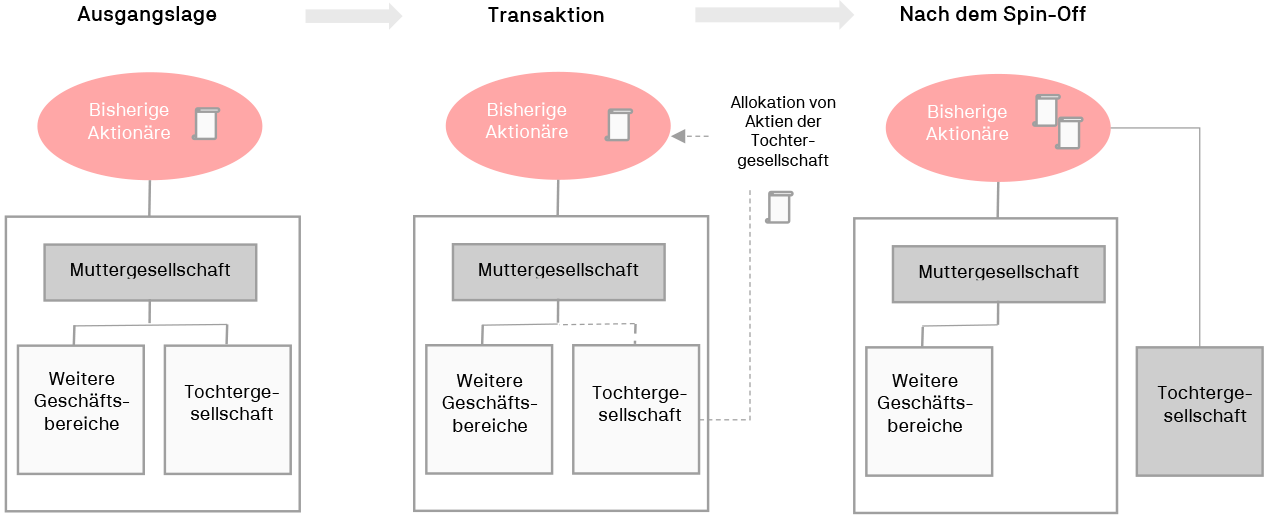
A spin-off is the pro-rata issuance of shares in the company to be divested to the shareholders of the parent company. Following the divestment, the shareholders of the parent company therefore own shares in two (or more) companies rather than one – both the shares of the parent company and the new shares of the divested subsidiary. In a classic spin-off, no funds from the transaction flow to either the parent company or the subsidiary. In many cases, the spin-off is carried out for 100% of the shares, so that the parent company no longer exercises any control over the former subsidiary.
As the illustration below shows, in the initial situation the shareholders hold only shares of the parent company. Upon completion of the transaction, the shares of the subsidiary are then distributed pro rata to the existing shareholders of the parent company. The result is two companies with an identical group of shareholders. Following the transaction, the spun-off company operates independently in the market and has its own governing bodies, management, administration and reporting.
Ablauf einer Abspaltung mittels Spin-Off
Source: Keynote Funds AG
Different motives for spinning off business divisions
The reasons for spin-offs are varied and manifold. Some companies, for example, wish to divest a low-margin business division that diverts attention from the parent company and requires capital that could be deployed elsewhere. Other companies seek, through a spin-off, to highlight the characteristics of a particular unit whose full value may not be reflected in the parent company's share price.
The main reasons frequently cited by companies for spin-offs are as follows:
Greater focus on the core business: A spin-off enables each company to concentrate on its priority strategic and operational plans, without human and financial resources being diverted from certain, potentially less important, business divisions.
A capital structure appropriate to the business: A spin-off enables each company to choose the capital structure best suited to its business, strategy and growth or cash-flow profile. Each company may have different capital requirements that often cannot be optimally addressed by a shared capital structure.
Elimination of the conglomerate discount: A spin-off creates distinct and targeted investment opportunities in each business division. A 'purer' company can be regarded as more transparent and more attractive to investors who focus on a specific sector or growth strategy, which counteracts the 'conglomerate discount' and increases the aggregate value of the two companies.
Share-based compensation: A spin-off will increase the effectiveness of both companies' share-based compensation programmes, as the value of compensation for employees, executives and directors becomes more closely tied to the performance of the company for which those individuals work.
Use of shares as acquisition currency: Creating a separate, publicly traded share for part of the parent company's business improves the ability of both the parent company and the spun-off company to carry out acquisitions using their shares as consideration.
In addition to these 'positive' reasons, a business division may also be spun off because it has a lower margin within the group or promises weaker revenue growth, and thus stands in the way of a higher valuation for the group. Or the parent company uses the spin-off to reduce its own debt, which it burdens the spun-off company with. In this way it can relieve its own balance sheet.
However, spin-offs can also be misused to shirk responsibility for environmental risks or other controversies, by hiving off the directly affected business units (e.g. problematic production facilities) into a legally independent construct. Such spin-offs are problematic and mostly also of little success, as will be explained later.
Gründe für Spin-Offs - Zusammenfassung
Source: Keynote Funds AG
The increasing trend towards sustainable investing has likewise led to spin-offs. In these cases, the business units that, from the parent company's perspective, are burdened with negative sustainability characteristics are hived off. A large corporation can, by spinning off a division that is problematic from an ESG perspective (e.g. coal mining), make its shares investable for sustainability-conscious investors.
Business divisions are particularly often spun off when they do not fit the company's core competency or when the company wishes to withdraw entirely from a particular field of business. While the parent company could also sell the division to be spun off, this is often associated with high tax burdens, which is why the route of a spin-off is chosen.
Although spin-offs often have strategic advantages, they can also entail a range of costs and risks, including:
the potential loss of revenue and cost synergies due to the separation of the parent company's business divisions;
spin-off costs;
smaller size and diversification, which can lead to greater cash-flow volatility and reduced access to the capital markets and can impair creditworthiness;
the decline in equity research coverage and investor focus if the spun-off companies are too small;
the increase in short-term share-price volatility until the market has adjusted to the different investment identities of the separated companies;
exclusion from stock market indices, depending on the size or nature of the companies; and …
increased vulnerability to unsolicited takeovers, since the business divisions of the two companies are less diversified and smaller after the spin-off than those of the combined predecessor company.
Many spin-offs arise from large conglomerates. These often become bloated and develop calcified structures, with the 'corporate headquarters' accounting for an ever-larger share of total costs but generating no revenue. When corporations become too large, they often can no longer be run efficiently owing to the high complexity – a situation that regularly leads to massive scandals and legal proceedings.
In the case of the aforementioned companies General Electric, Johnson & Johnson and Kellogg Company, these reasons at least accelerated the split-up. GE and J&J had to pay billions of dollars in fines for corporate misconduct. A misguided acquisition strategy at GE led to an accumulation of debt and problematic accounting practices, while J&J stood trial in connection with the opioid crisis in the USA and for the knowing use of carcinogenic substances in the manufacture of baby powder. In recent years, Kellogg's famous cereal brands have lagged behind the global snacking portfolio in popularity – and in profits. With its many different orientations, the company became unwieldy. Since then, Kellogg's own brands have been forced to compete for money and time. The split-up is intended to remedy this problem.
Shareholder activism is another potential driver of spin-off activity. Shareholder activists have become a powerful force in the corporate landscape, and many advocate value-maximising measures, often in the form of spin-offs. At GE, too, it was not least shareholder activists who contributed to the decision to spin off divisions.
The structuring of spin-offs
In restructuring a company by hiving off one or more business units (divestitures), a distinction can be made between spin-offs, split-offs and equity carve-outs. In a spin-off, the shareholders of the parent company receive shares in the subsidiary to be divested. In a split-off, the shareholders of the parent company can exchange their shares for a defined number of shares in the new subsidiary. In a carve-out, the parent company sells part of its stake in the subsidiary to the public via an initial public offering, whereby the subsidiary becomes a standalone company. In the USA, parent companies can sell up to 19.9% of their stake in a newly formed corporate entity tax-free before a full spin-off then takes place at a later point in time.
The difference between a spin-off and a split-off is that, in the case of a spin-off, the shareholders of the original company own shares in two companies (the parent company and the subsidiary) after the transaction, whereas in a split-off they hold only shares in the subsidiary (or, if they do not participate, in the parent company). In a carve-out, the biggest difference is that new shareholders come on board and the parent company likewise becomes a shareholder of the new company.
A further variant is a so-called 'Reverse Morris' transaction. In this, a business division or other assets are hived off into a separate company and then merged (tax-free) with another company.
Verschiedene Divestitions-Arten
Source: Keynote Funds
The number of spin-offs
According to Bloomberg, 820 spin-offs were carried out worldwide between 2000 and 2021. The most active period was between 2012 and 2015, while the lowest activity was observed from 2000 to 2003 and from 2017 to 2021. This trajectory indicates that spin-offs follow the cycle of mergers and acquisitions (M&A) and initial public offerings (IPOs) with some time lag (see the chart below).
Anzahl Spin-Offs pro Jahr (2021 bis 2021)
Source: Bloomberg, Keynote Funds
Acquisitions and mergers often give rise to larger, more complex corporations with a diminishing strategic focus and declining capital efficiency. The lack of management capacity and the often excessive prices mean that investors are disappointed and the conglomerate discount increases. It is hardly surprising that in such a situation a spin-off is pursued as a viable solution, and that accordingly, following increased acquisition and merger activity, spin-offs are increasingly undertaken as a consequence.
However, unlike IPOs (the better the market performance, the more frequent the flotations), spin-offs are carried out in all market phases. A possible investment universe that considers not only the spun-off units but also the parent companies has, over the past 17 years, consisted of between 150 and 250 opportunities (based on rolling five-year windows; see the chart below).
Anlageuniversum von Spin-Offs und Muttergesellschaften (5 Jahre rollierend)
Source: Bloomberg, Keynote Funds
Broadly based across sectors and regions
Restructuring companies by means of spin-offs is, especially in the USA, a widely used means (around 60% of spin-offs worldwide) of improving companies' focus and reducing the conglomerate discount on the financial markets. However, spin-offs are also increasingly taking place in other regions of the world, particularly in Europe and the Asia-Pacific region. It can be expected that North America will remain the most active market for spin-offs, but the frequency of restructurings through the spin-off of business segments is likely to continue to increase in Europe, Asia and Australia.
It is also interesting that spin-offs are not a sector-specific phenomenon, since spin-offs with subsequent stock market listing take place across all sectors (see the illustration below). This is significant above all because an investment strategy targeting spin-offs has no so-called 'sector tilt': by this we mean that the performance of a sector cannot excessively influence the results of a spin-off equity strategy, provided the portfolio is sufficiently diversified.
Spin-Offs nach Branchen, 2000 bis 2021
Source: Bloomberg, Keynote Funds
Many investors have painfully experienced in recent years what impact such a 'sector tilt' can have. Many so-called 'thematic funds' promise to profit from a theme but have ultimately disappointed: firstly, because the theme was on everyone's lips at the time the fund was launched (artificial intelligence, metaverse, cannabis, etc.), which mostly proved to be a poor time to invest in such companies, and secondly, because the 'sector tilt' meant that the results were more closely linked to the performance of one or a few sectors than to the actual theme.
Spinning off business divisions into standalone listed companies can therefore be entirely sensible. From an investor's perspective, the question arises as to whether such situations also represent worthwhile equity investments. On this, some of the most successful investors have expressed their views as follows:
'You can make a bundle of money investing in spin-offs. The facts are overwhelming. The shares of spin-off companies significantly and consistently outperform the market averages.'
Joel Greenblatt You Can Be a Stock Market Genius
'Spin-offs of business units into separate, standalone entities often result in astonishingly lucrative investments.'
Peter Lynch One Up on Wall Street
'Study spin-offs carefully.'
Charlie Munger
'Spin-offs often offer attractive opportunities for value investors.'
Seth Klarman Margin of Safety
It is remarkable how much importance these 'star investors' attach to this segment of the equity market when it comes to identifying worthwhile equity investments. As Joel Greenblatt notes, the facts are indeed overwhelming. There are many studies that have examined different time periods (see the table below).
Component could not be found for blok TableHtml! Is it configured correctly?
All the studies reach the same conclusion: over the past five decades, spin-off shares have achieved positive and economically significant excess returns relative to the broad equity market over a period of 12 to 36 months following the divestment. Evidently the strategy has worked over five decades, regardless of whether inflation, deflation, a value or growth cycle prevailed as the 'dominant market regime'.
One of the more recent studies, by S&P Global in 2017, which examined spin-offs over the period from 1989 to 2015, concludes that spin-offs record a clear excess return relative to the respective sector over a period of one and three years respectively. While the spin-off is above all promising in share-price terms for the new listed company, the shares of the remaining parent companies can also record interesting positive price developments after the spin-off.
Überrendite von Spin-Offs und Muttergesellschaften vs. Sektor
Source: S&P Global Market Intelligence, Keynote Funds
The study concludes that shares of spin-offs achieved a return 8.4% higher over the one-year period following the completed spin-off than shares of companies from the same sector. Over three years, the return was even 22.1% higher. While a comparable excess return could not be established for parent companies, there are nevertheless situations in which the parent company's share, too, benefits from the separation of a business division – be it through a better margin and growth profile after the spin-off or through the elimination of the conglomerate discount and a correspondingly higher valuation.
So while practically all studies substantiate that, on average, an excess return can be generated with spin-offs, a study by Deloitte from 2014 shows that the differences between the best and the worst spin-offs are wide apart (see the chart below).
Wertentwicklung der Muttergesellschaften und Spin-Offs ein Jahr nach der Abspaltung im Vergleich zum Weltaktienindex
Source: The Edge Group / Deloitte
This study examined not only how spin-offs and parent companies performed on average, but additionally analysed how large the divergence between the best and worst shares was. The top quartile accordingly comprises the 25% of shares that performed best, while the bottom quartile contains the 25% of worst-performing stocks. This shows not only that spin-offs achieved a return of around 22% on average one year after the spin-off, but also that the best 25% of spin-offs achieved a performance of a hefty 98%. The worst spin-offs had to accept a decline in value of 39%. So if an investor manages to avoid the worst spin-offs and invest primarily in the best situations, their return will come to lie well above the average of 22%.
This study shows that one should not simply invest blindly in every spin-off situation, but rather that positive selection can once again significantly improve the return. That such large differences in return arise also indicates that this is an inefficient niche of the equity market, where excess returns are still to be found.
The 'spin-off mechanics'
Another interesting finding from the many academic studies relates to the timing of the performance progression of spin-offs. Many studies, including the aforementioned study by S&P Global, show an interesting and recurring pattern when considering the performance of spin-offs: while a clear excess return results over one and three years, the shares of the spun-off companies perform considerably worse in the short term. In the first 3 months after the spin-off, spin-offs often achieve a markedly below-average performance (see the illustration below).
The initial selling pressure arises primarily from the following reasons:
Existing shareholders do not want the shares: Investors often have no interest in the newly received share – they originally bought the share of the overall group and may not necessarily be interested in the spun-off business unit. Many, especially smaller, investors sell the newly received shares in response.
Index-oriented investors have to sell: Owing to the smaller market capitalisation of the spin-off, the shares of the spun-off company are not included in the same indices as the overall group before the spin-off. Accordingly, index-oriented investors such as ETFs must in any event dispose of the newly received shares.
Lack of analyst coverage: Unlike with the initial listing of shares (IPOs), no new funds flow to the company in the transaction; rather, the shares of the new company are distributed to shareholders free of charge. Accordingly, the spun-off company and its prospects are also not marketed in order to achieve the highest possible valuation. Investment banks and analysts therefore have no initial interest in spin-offs.
Mehrrendite von Spin-Offs im Zeitablauf (1989 bis 2016)
Source: S&P Global Market Intelligence Quantamental Research
This selling pressure means that shares of spin-offs often achieve a negative performance over the first few months. However, in the following quarters the company can demonstrate that it can achieve operational improvements and that the newly embarked-upon direction is bearing its first fruits. The discrepancy discernible at this point between the attractive operational prospects and the low valuation draws the attention of the first investors and analysts, and the spin-off share can achieve the positive results that the multitude of academic studies have established over one and three years.
However, it should be mentioned in this context that this progression is not to be observed in exactly the same way with every spin-off. In some situations the selling pressure can persist longer, while in others it is barely discernible. In any event, the spin-off 'mechanics' offer those investors who engage in detail with the spin-off the opportunity to acquire the share at an attractive price shortly after the spin-off and thereafter to profit from the focusing and the operational progress.
Conclusion: spin-offs represent an attractive market niche
The academic evidence shows that spin-offs can represent attractive investment opportunities. Spin-offs from inefficient conglomerates, which are released into 'freedom' and thereby realise operational improvements, often also experience above-average price performance.
In this, it is of great importance to separate the 'good' spin-offs from the 'bad'. Among other things, the reason for which a spin-off was pursued is important here. These are often companies established for decades already, with a strong market position, which realise operational improvements through the spin-off. Given the 'spin-off mechanics' (selling pressure immediately after the spin-off), extremely attractive investment opportunities arise for those investors who take the time to scrutinise the situation and the spun-off company more closely.
In the second Keynote Insights series on the topic of spin-offs, you will learn what should be given particular attention when assessing companies that are splitting up, and which spin-offs currently appear promising.